

You may notice the blue before you recognize the cross. In the artwork above, horizontal marks meet a tall central band, while cream, ochre, and blue passages overlap around them. The subject gradually becomes clearer as you look. The picture asks something different of us than a carefully drawn biblical scene.
Abstract Christian art can communicate through recognizable imagery, a documented Scripture connection, and the relationships between color and form. It can also give a contemporary room a strong focal point. Four works from Lamb’s Love’s abstract Christian wall art collection show the range: a cross, a dove, an empty tomb, and light over water. Looking at each closely helps us separate its biblical meaning from the choices that make it visually compelling.
Featured above: Contemporary Abstract Cross Wall Art in a living-room mockup. Room images illustrate placement and styling; check the selected product’s finished dimensions and frame option for your space.
What Makes Abstract Art Christian?
An abstract artwork can express Christian meaning through a recognizable Christian symbol, a stated biblical subject, Scripture, or an accompanying explanation grounded in faith. Its meaning should be identifiable rather than assumed from the mood it creates.
A cross directs us toward Christ’s crucifixion. An empty-tomb motif relates to His resurrection when that connection is established. A painting of light over water may need its title and passage to explain why it appears in a Christian collection. The viewer’s response matters, but feeling peaceful or moved does not by itself establish the artist’s beliefs or the work’s subject.
Abstraction also comes in degrees. A dove can remain recognizable while the surrounding marks have little resemblance to a literal place. A landscape can retain a horizon and reflections while loosening the shapes of trees or clouds. These works are partly representational; they are not all nonobjective pictures with no recognizable subject.
The National Gallery’s explanation of abstraction is useful here: even a picture of the visible world has relationships of line, form, tone, and color that can be considered apart from what it depicts. That gives us two good questions: what does this picture refer to, and how do its parts work together?
Color, Form, and Texture: Where to Begin Looking
Start with the strongest contrast. The pale dove stands apart from darker blue marks; the tomb opening gives surrounding lighter areas a shape to gather around. That first point of attention is often called the focal point. A work may have more than one, but noticing their order makes a complex image easier to follow.
Then look for repeated directions. Vertical bands can carry attention upward; horizontal passages can spread it across the surface. A succession of marks creates visual rhythm, rather like repeated accents in a piece of music. Broad areas with fewer changes can give those busier passages space.
Compare warm and cool colors. Ochre and cream sit beside blue and blue-gray in the featured works. That contrast can make one area more noticeable without requiring a large change in brightness. It is a visual relationship, not a biblical code. Gold-colored marks do not always mean divinity, and blue does not automatically mean heaven.
Finally, look at edges and apparent texture. Broken, overlapping marks can suggest scraping, brushing, or layering. In these products, that painterly appearance is reproduced in a print. It should not be read as a promise of raised paint, genuine gold leaf, or a metallic finish. Your chosen paper or canvas has its own surface.
A Brief History of Abstraction and Spiritual Expression
Modern abstraction developed through different experiments rather than one shared religious program. As the National Gallery notes, artists increasingly emphasized and isolated formal qualities from the late nineteenth century onward. By the early twentieth century, some were exploring pictures that departed much further from naturalistic representation.
One influential example is Vasily Kandinsky. MoMA’s account of Kandinsky’s spiritual interests discusses his 1911 book Concerning the Spiritual in Art and his interest in expression, spirituality, and music as a model for composition. His work moved toward dynamic arrangements of form and color.
That history helps explain why abstraction can carry ideas beyond literal description. It does not make all abstract art Christian, equate every spiritual theory with biblical faith, or establish a direct influence on Lamb’s Love’s designs. Here, the Christian connections come from the particular subjects and passages stated with the artwork.
Behind the Art: Four Different Relationships Between Image and Meaning
A cross formed through overlapping marks
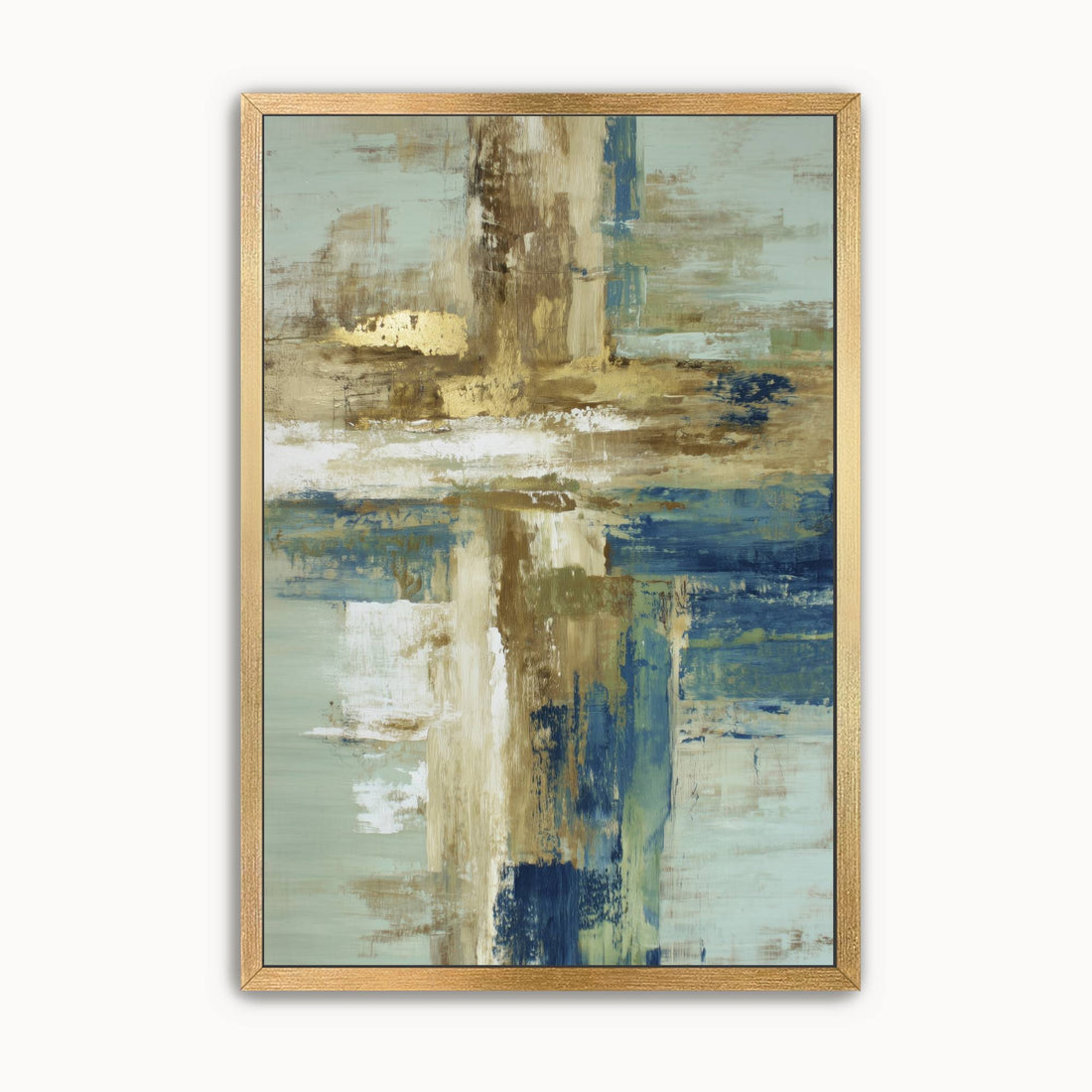
In Contemporary Abstract Cross Wall Art, a broad light horizontal passage crosses a taller ochre-and-cream band. Blue marks gather along its right side and lower area, while paler sections leave other parts more open. The edges break and overlap. This makes the cross part of the painting’s activity instead of a separate emblem placed on top.
The listing connects the work to Isaiah 53:5 and Galatians 6:14. Christians read Isaiah’s suffering-servant passage in relation to Jesus bearing sin; Paul’s words in Galatians center his boasting on the cross of Christ. The image can lead toward that message, but the brushwork itself does not explain redemption. Christ died for sinners and rose again; forgiveness and new life are received through faith in Him.
The living-room mockup at the top gives the image a clear role. A low, light wood cabinet stretches horizontally beneath the vertical picture. Cream ceramics relate to the pale passages, while the fern supplies a different green accent. The blue remains distinctive against the warm wood and neutral wall. Nearby woven and knitted textures add material interest without repeating the art’s irregular marks.
If the picture is the room’s main focal point, keep some of the furniture and accessories simpler. It does not need matching blue objects on every surface. One small connection elsewhere—a cushion, book cover, or ceramic bowl—may be enough, if you want one at all.
A recognizable dove in a less literal setting
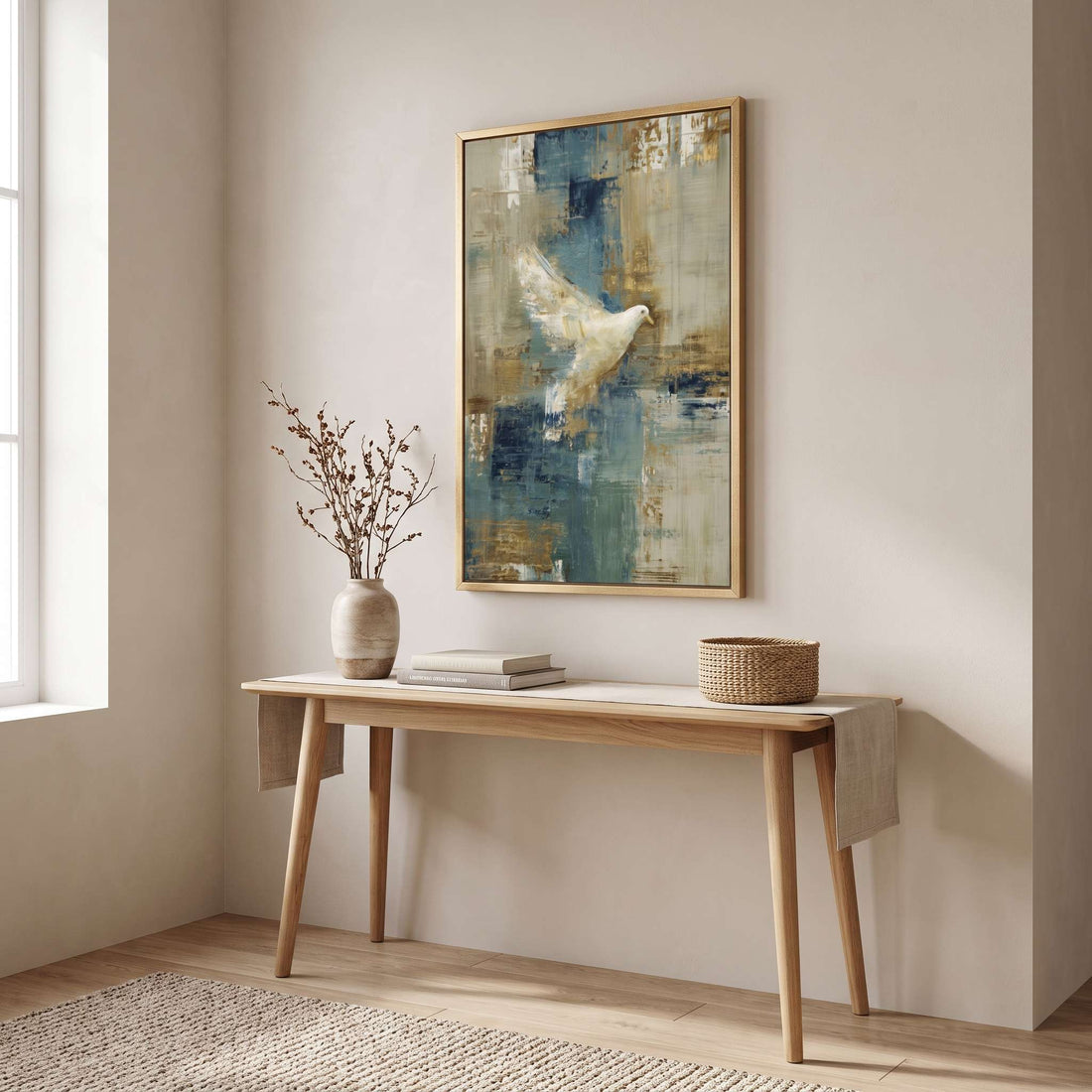
Contemporary White Dove Wall Art keeps the bird’s head, body, and lifted wings recognizable. Around it, blue and warm neutral passages read as layered color rather than a precisely described sky. The pale bird crosses those changes, giving the eye a shape to return to.
Its Christian association comes from Matthew 3:16, where the Spirit of God descends like a dove at Jesus’ baptism. The image recalls that biblical language. It is not a claim that the Holy Spirit is a bird or that hanging the picture brings His presence into a home.
The entryway mockup makes the picture the most active surface. A pale wood console has a quiet outline; the woven basket and branching stems introduce smaller variations below. The light-toned frame keeps a visible border without enclosing the picture in a large dark block. Position tall branches to the side so they do not obscure the dove.
This can work in a Scandinavian-inspired or neutral contemporary entryway because there is a specific balance: simple furniture, natural materials, and one concentrated area of color. The useful principle is that relationship, rather than the style label.
An empty tomb defined by light and an opening
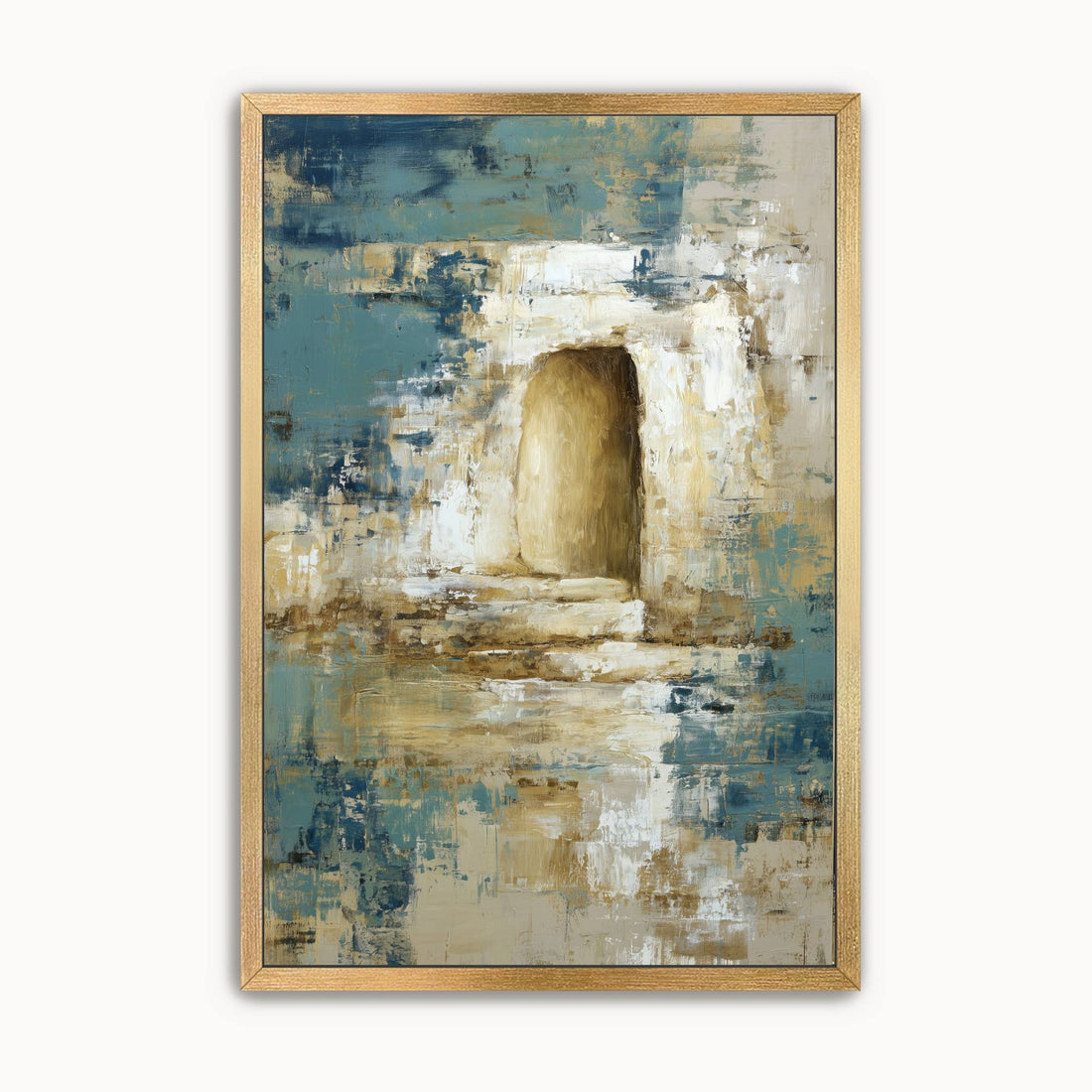
In Contemporary Empty Tomb Wall Art, an arched opening sits within pale, broken marks. Horizontal ledges or steps lead toward it; blue areas interrupt the surrounding cream and ochre. The opening has enough definition to hold attention, while much of its setting remains loosely described.
The listing identifies Matthew 28:6 as its biblical basis. In Matthew’s resurrection account, the women hear that the crucified Jesus has risen and then meet Him. Christian hope rests on that resurrection, not simply on the appealing idea of light overcoming darkness. The pictured light and architecture are an artistic interpretation, not archaeological documentation.
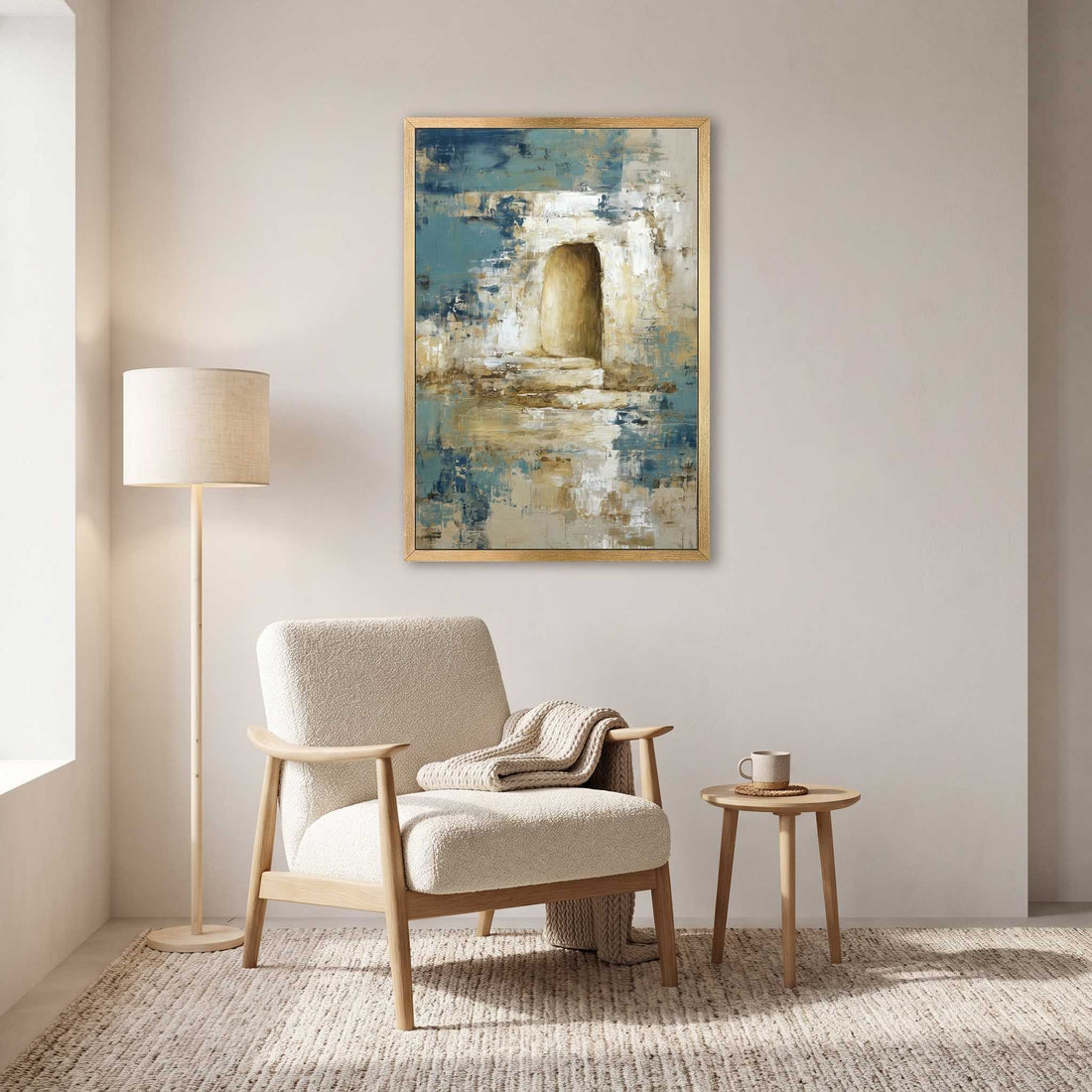
Here, a wood-framed cream chair, a round side table, and a floor lamp provide a practical place to sit. The art adds richer blue and ochre to the otherwise pale corner. Its frame relates to the warmer room details, while the loosely painted surface contrasts with the furniture’s clear edges.
Leave room for the lamp and the view from the chair. An artwork may look centered from the doorway but feel awkwardly high when seated. A paper outline helps you test both positions. This subject can remain on the wall throughout the year; the resurrection is central to Christian faith beyond Easter.
Light over water, with a connection supplied by Scripture
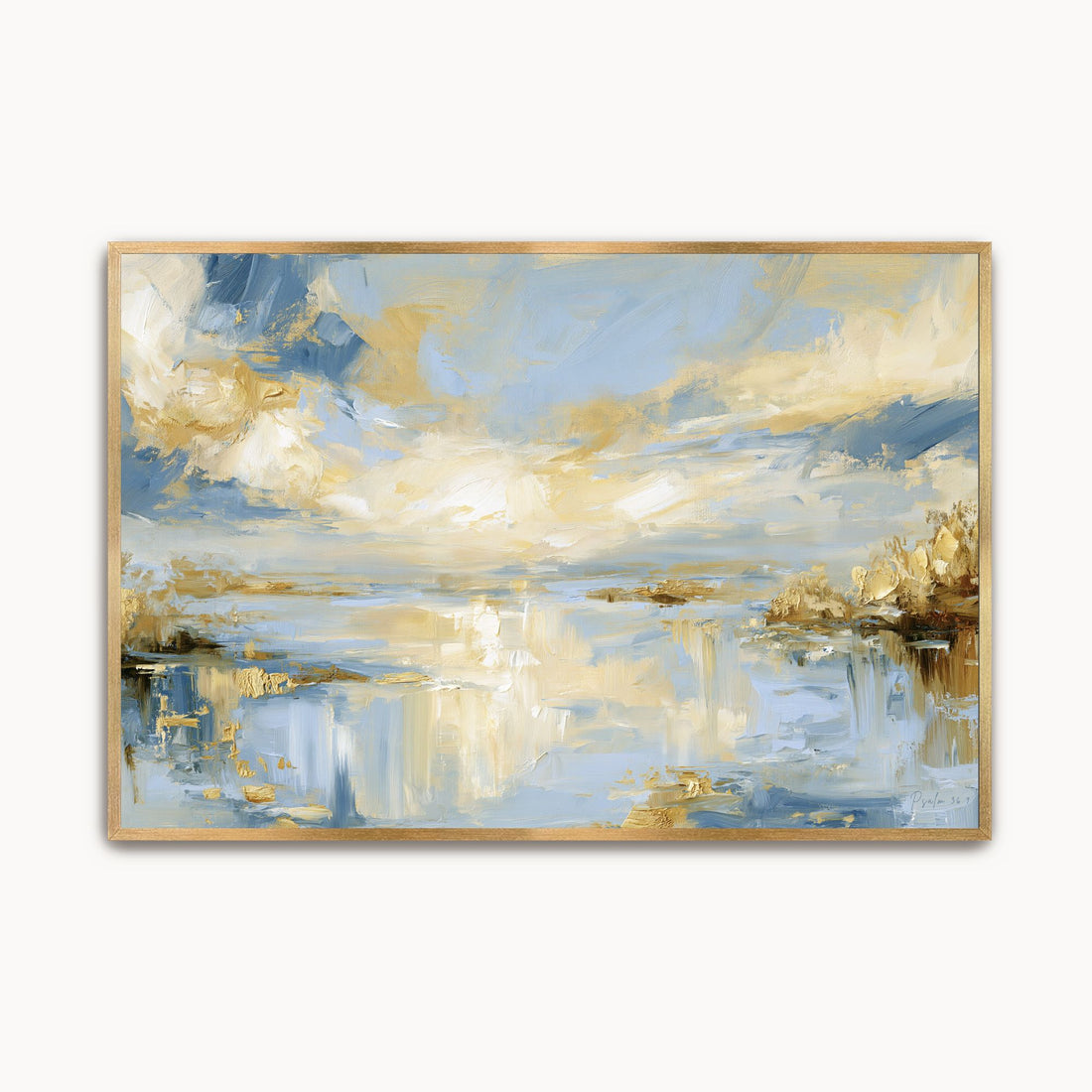
In Your Light We See Light takes a less emblematic approach. There is no clearly isolated cross or dove. A low horizon, a pale center, and a vertical reflection suggest light spreading over water. Blue and cream passages recur above and below, with warmer marks near the banks and sky.
The title establishes Psalm 36:9 as the connection. The surrounding psalm praises God’s steadfast love, faithfulness, provision, and life-giving presence. Its light language is richer than sunlight on a lake. Reading Psalm 36:5–10 gives the landscape a stated context without pretending that every bright reflection is a biblical symbol.
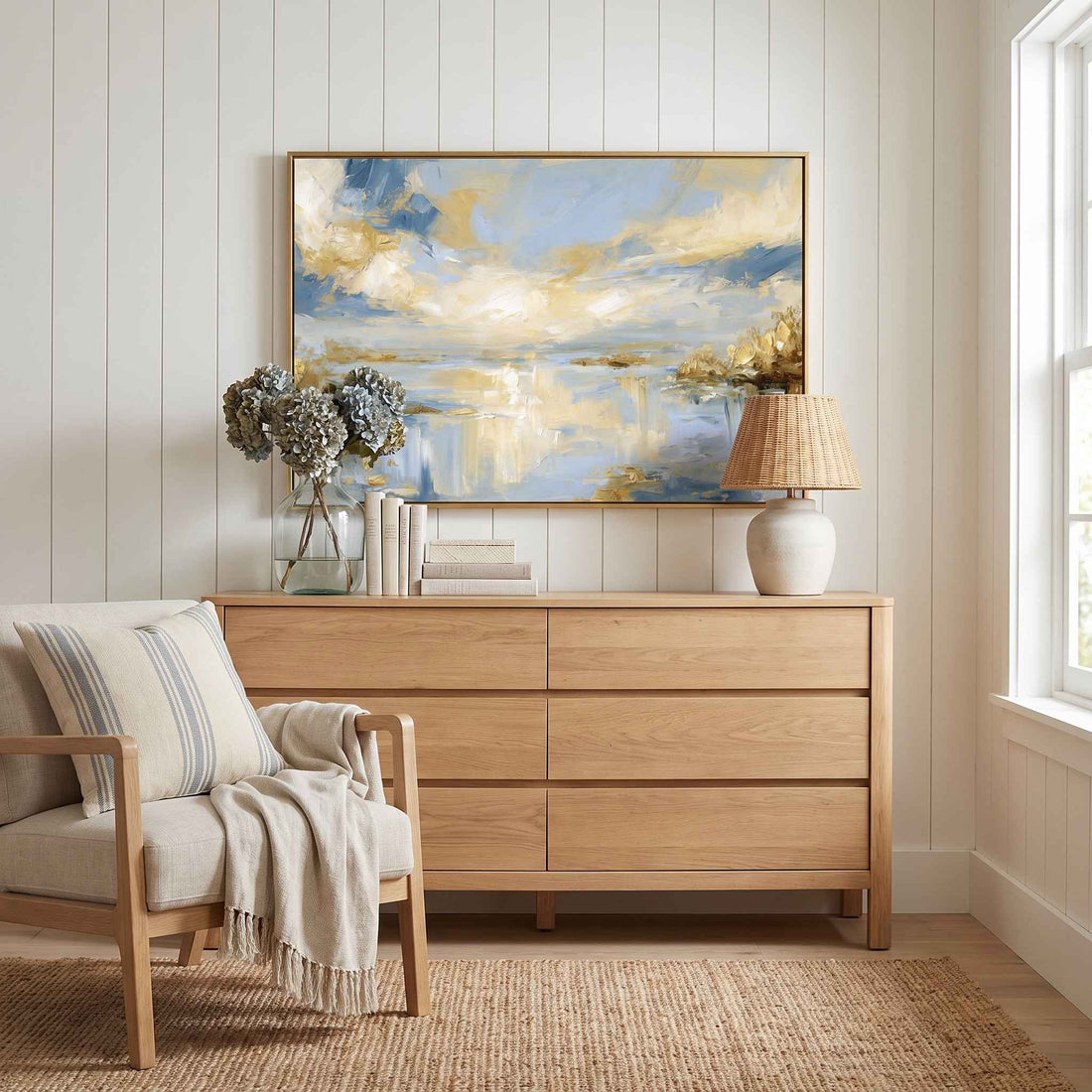
The dresser arrangement shows an organic modern direction with more color than an all-neutral scheme. The wood furniture and woven lampshade provide warmth; the painting’s blues keep the view from relying entirely on beige. A broad horizontal image relates to the dresser without having to reach its outer edges.
In the mockup, flowers and the lampshade overlap the picture’s lower corners. Treat that as a choice to evaluate, rather than a requirement to copy. Lower objects would reveal more of the image. If you prefer to see the whole composition, move taller accessories outward and leave the central reflection unobstructed.
Choosing Abstract Christian Art for Your Space
Choose how explicit you want the subject to be. A cross or dove can register quickly; an abstract landscape may invite a conversation about its title. Neither approach makes a home more faithful. Choose a biblical theme you understand and a composition you enjoy seeing repeatedly.
Decide whether it should lead or support the room. Stronger contrast and busier marks can draw attention. If a room already has patterned upholstery, open shelves, and several competing focal points, give the artwork a clearer area of wall or choose a less active image. For a sofa wall, test the whole arrangement from the entrance and seating area, rather than judging only the empty wall.
Compare warmth, coolness, and frame finish. Blue passages may provide contrast beside warm wood; cream and ochre can connect with upholstery or a lamp. A Golden frame emphasizes a warm edge, while Maple Wood can relate to lighter furniture. Black creates a firmer boundary. Check the actual finish options and consider them under your own lighting.
Measure before selecting the format. The four featured listings currently offer Poster and Canvas materials, with unframed choices and several frame finishes. Dimensions and orientation vary. Tape up the finished outline, including a frame if selected, and inspect it from the places where you will see it. Room mockups are not scale drawings, and painterly marks remain printed imagery in either format.
Minimalist and abstract are different descriptions. Minimalism concerns restraint; abstraction concerns the relationship between forms and recognizable reality. A simple cross can be both, while these layered designs are often more visually active. Compare our minimalist art examples or the minimalist collection if you prefer a quieter surface.
For other directions, our Christian wall art styles guide compares styles, and the modern-home guide considers the broader decorating context.
Questions About Abstract Christian Art
Does abstract Christian art need printed Scripture?
No. A recognizable subject and a clear explanation can establish its Christian connection. If having exact words visible is your priority, choose a Scripture-focused design and check the wording and readability. An abstract image may accompany Bible reading or conversation without communicating the entire passage on its own.
Can I combine abstract art with a traditional painting?
Yes. Compare their scale, colors, and framing rather than assuming their labels must match. A shared blue-gray or warm cream can connect different treatments. Let one image take the stronger role, and give both enough space. You can test the arrangement with paper outlines before committing to additional pieces.
Do I need to find a spiritual meaning in every mark?
No. Some marks organize the picture, create contrast, or suggest a surface. Begin with the stated subject and Bible passage. Personal associations can enrich your response, but they should not become rules about what every color means or claims about an artist’s undocumented intentions.
The cross in the opening picture becomes clearer when we give it a little time. That is part of the interest of abstraction: recognition and looking can happen together. Lamb’s Love’s mission, “The Story of God’s Love, Made Visible,” invites attention to the Christian story as well as the image. Explore the abstract artwork with a subject and a room in mind, leaving Scripture to guide the meaning and your own careful looking to guide the choice.

