

Above a light wood desk, an ivory cross sits against sage green. A white lamp echoes its pale lines; the wood frame relates to the desk below. The laptop and a small stack of books have room of their own. The picture is easy to notice because so little competes with it.
That is the appeal of minimalist Christian wall art: a recognizable subject given a clear place in the room. It can be a symbol, a few lines describing Jesus with a lamb, or Scripture arranged with generous margins. Our minimalist collection includes several approaches. Looking closely at five of them shows how restrained design works—and how to choose art that belongs with the furnishings you already enjoy.
Featured above: Minimalist Cross Wall Art | Modern Christian Faith Decor in a home-office mockup. Room images illustrate styling; confirm the selected product’s dimensions and framing before ordering.
What Makes Christian Wall Art Minimalist?
Minimalist Christian wall art uses fewer visual elements to give a biblical subject, symbol, or passage a clear emphasis. It may rely on open space, simplified outlines, a limited palette, or carefully arranged type. It does not have to be entirely white, completely abstract, or free of detail.
Negative space means the area around and between the main forms. In a cross design, the green field surrounding the ivory shape lets its silhouette register immediately. In a line drawing, unfilled areas help separate the figure, the lamb, and the background. Empty-looking space is doing useful work.
Visual hierarchy is the order in which things catch your eye. A large cross reads before its finer parallel lines. In a Scripture print, the main wording may stand out before the verse reference. When too many elements have equal weight, neither the image nor the text has an obvious starting point.
This is a visual preference, not a measure of faithfulness. Detailed paintings and richly colored art can express Christian truth just as thoughtfully. Our Christian wall art styles guide offers the wider comparison; here we are looking at what restraint makes possible.
Simple Forms Still Need a Clear Biblical Meaning
A cross is recognizable with very few marks, but its Christian meaning comes from Christ’s crucifixion. In 1 Corinthians 1:18–25, Paul centers his message on Christ crucified and the power of God. An attractive shape should lead back to that saving work, rather than turn the cross into a general sign of positivity.
A dove needs explanation of a different kind. Matthew 3:16–17 describes the Spirit of God descending like a dove at Jesus’ baptism. The symbol recalls that passage; the Holy Spirit is not simply a bird, and displaying the image does not bring His presence into a room.
Other designs tell a story through posture or words. Jesus holding a lamb draws attention to His care, while John 10:11–18 identifies Him as the Shepherd who lays down His life and takes it up again. Scripture typography makes its connection through readable language. In every case, the passage supplies more meaning than the color palette can.
A Short History: Minimalist Style and Minimalism Are Different
MoMA describes Minimalism as a primarily American movement of the 1960s associated with simplified geometric forms, industrial materials, and nonrepresentational work. Its artists challenged established expectations about how art should be made and encountered.
“Minimalist” in home décor is a broader description. A drawing of Jesus or a printed Bible passage still represents something specific; it is not the same kind of work as a nonrepresentational Minimalist sculpture. Lamb’s Love uses the term for a restrained visual approach, without claiming a direct lineage from those artists or a single historical movement called minimalist Christianity.
Behind the Art: Five Ways to Use Restraint at Home
An ivory cross: color and line in an organic modern workspace
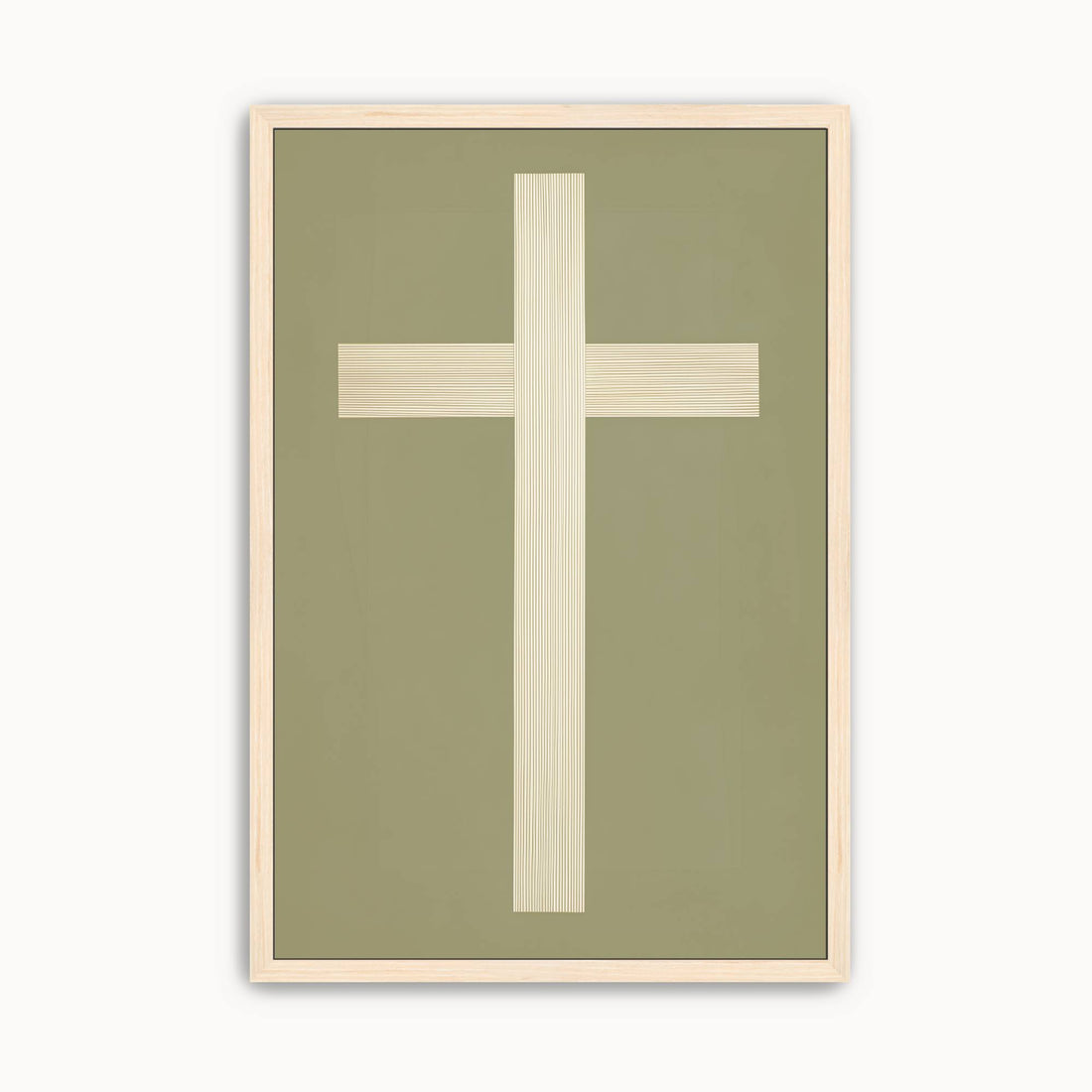
Look at Minimalist Cross Wall Art beyond its outline. Closely spaced ivory lines form the upright and crossbar. From farther away they read as one pale shape; nearby, their direction becomes visible. This is printed visual detail, not raised carving or applied strips of wood.
The home-office image at the top shows a practical organic modern pairing: green, pale wood, a ceramic-looking lamp, and a rounded vase. The art’s broad green field gives the desk a color anchor. Its light frame connects with the furniture without requiring the wood tones to match exactly. The laptop adds a small dark contrast, so the arrangement does not dissolve into beige.
If your desk already has shelves, cables, and several screens, give the picture some separation from those edges. One larger, clearly placed piece may be easier to read than several small items crowded into the remaining gaps. Measure first; the mockup is inspiration, not a scale diagram.
A white dove: an entryway with wood and woven texture
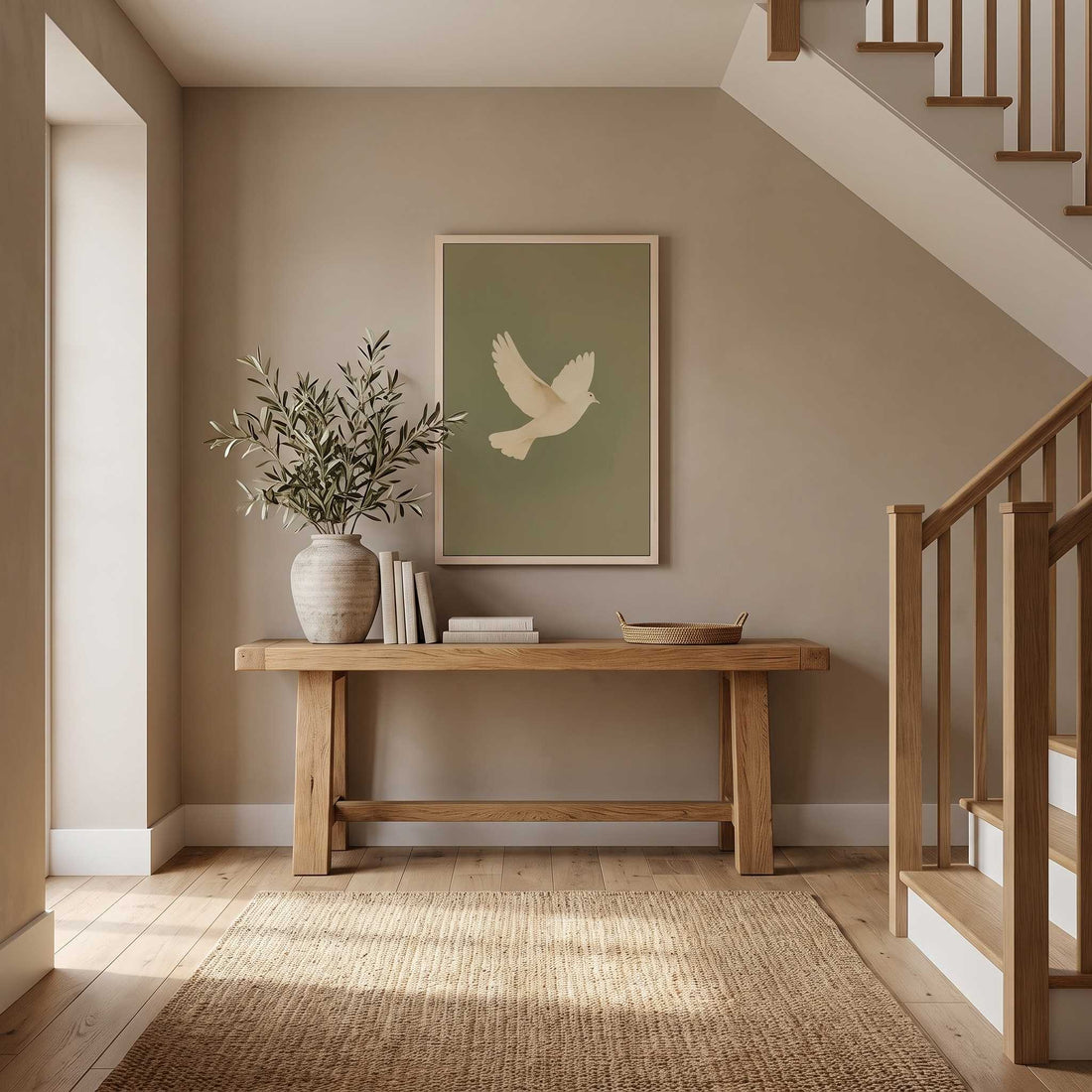
In Minimalist White Dove Wall Art, the pale bird’s lifted wings interrupt a largely uninterrupted green background. The image has movement, but no dense scenery. Its biblical association is stated in the product’s Matthew 3:16 connection.
The staircase-entryway mockup shows why this can suit a Scandinavian-inspired arrangement. Pale flooring and straightforward wood furniture keep the room light; the woven tray and rug supply texture that the art does not need to repeat. Green in the leafy branches connects with the print, while the ivory bird stands apart from both.
Notice the asymmetry. A taller vase occupies one side of the console, and lower books and a tray balance the other. You could adapt that arrangement with a lamp and a key dish. Leave the artwork visible, and avoid placing tall stems directly across its subject. A useful entryway still needs somewhere to put the things you carry home.
Psalm 121: typography beside a reading chair
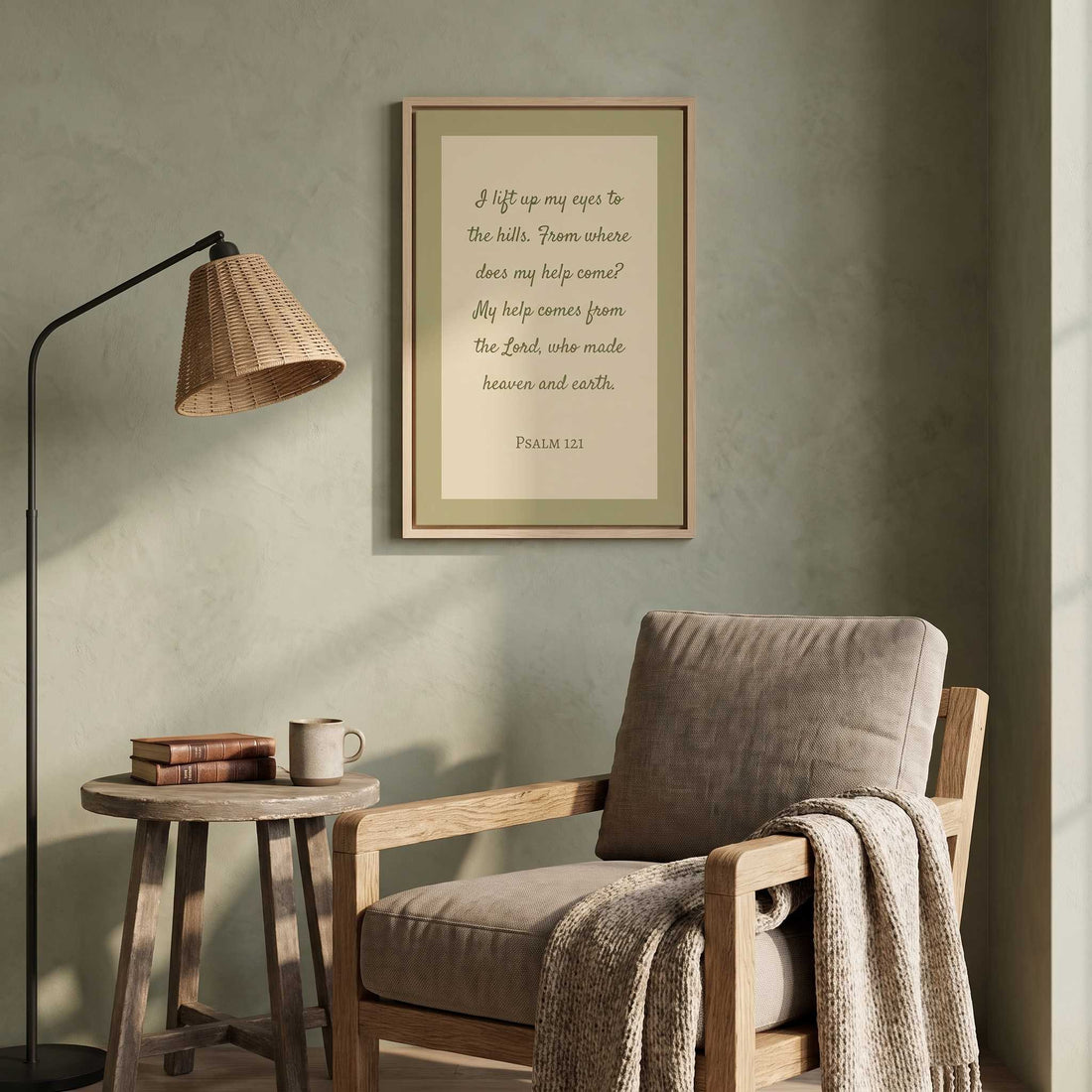
Minimalist Psalm 121:1–2 Scripture Wall Art places flowing dark lettering inside a pale panel and muted green border. It offers a different kind of simplicity: words become the subject. The margins organize the passage without adding a surrounding illustration.
This reading nook suggests a Japandi-inspired pairing of restrained furnishings and natural materials: a wood-framed upholstered chair, a small table, a woven lampshade, and a textured throw. You do not need to reproduce a complete design style. Here, the relevant connection is between the print’s green border and wall color, with pale upholstery and paper providing lighter areas.
Readability matters more than the label. Flowing script asks for closer attention than a bold symbol. Put a Scripture design near a place where you pause, and check the lettering in the actual product image at your intended viewing distance. The psalm directs trust toward the Lord who made heaven and earth—not toward the hills themselves. Reading Psalm 121 as a whole keeps the excerpt connected to its assurance of God’s care.
The Good Shepherd: an expressive drawing in a neutral room
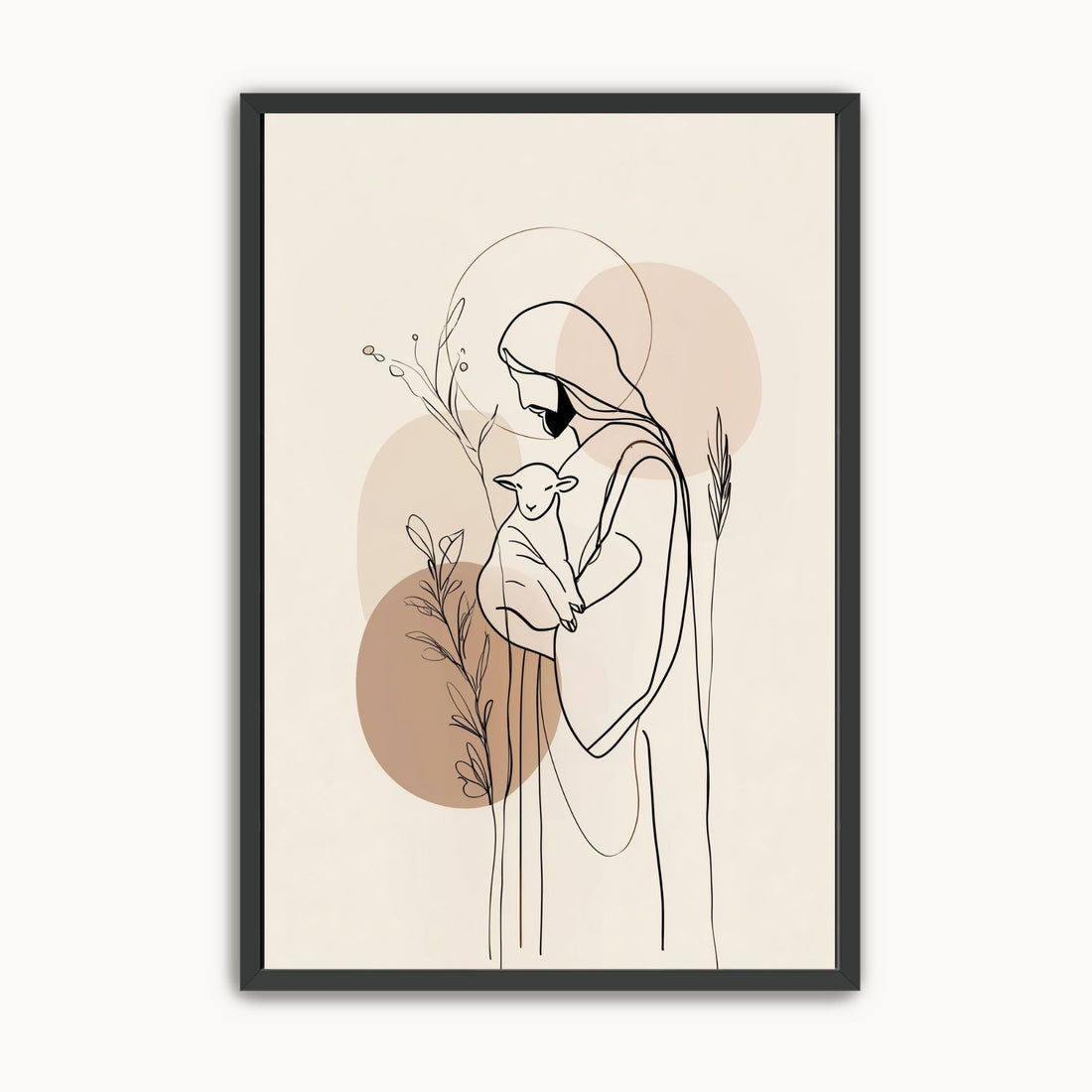
Minimalist Good Shepherd Christian Wall Art uses dark contours to describe Jesus’ lowered head, arms, robe, and the lamb. Botanical lines and overlapping beige forms add interest without constructing a detailed landscape. It is figurative line art with abstract background shapes, rather than a wholly abstract image.
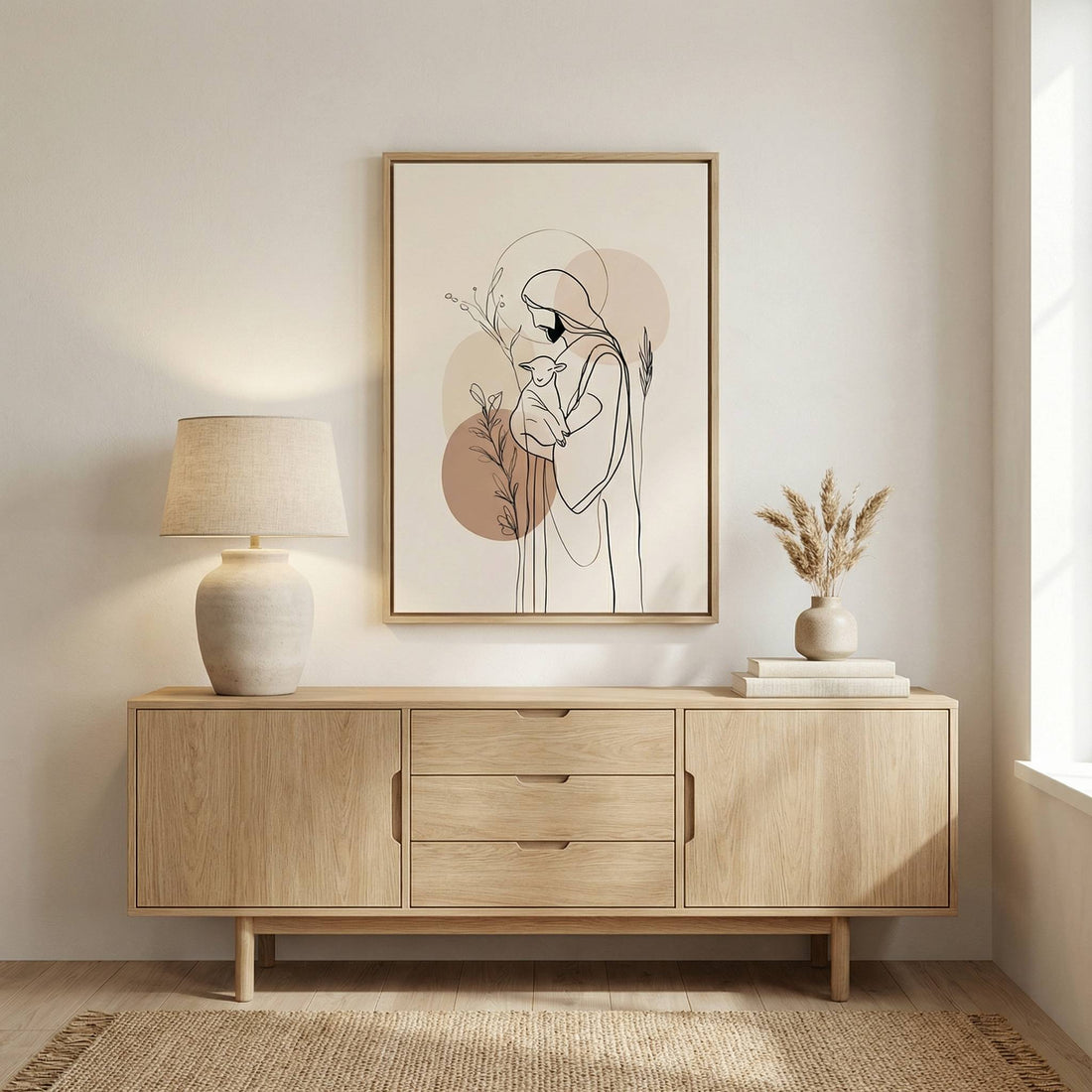
The sideboard mockup shows how a neutral contemporary room can accommodate line art without feeling empty. Wood grain, a woven rug, and rounded ceramic forms carry much of the material interest. The drawing supplies a human subject and darker marks. Its vertical shape sits between the lower lamp and vase rather than tracing the full width of the cabinet.
A black frame, shown in the closer artwork image, would emphasize those dark contours; a lighter finish, as in the room image, gives a gentler boundary. Neither choice requires replacing the furniture. If a textured sofa sits nearby, the broad, lightly filled background can give the eye a simpler neighboring surface. John 10 remains the reason for the subject: Christ’s care is inseparable from His self-giving love.
The Last Supper: a softer approach for a dining room
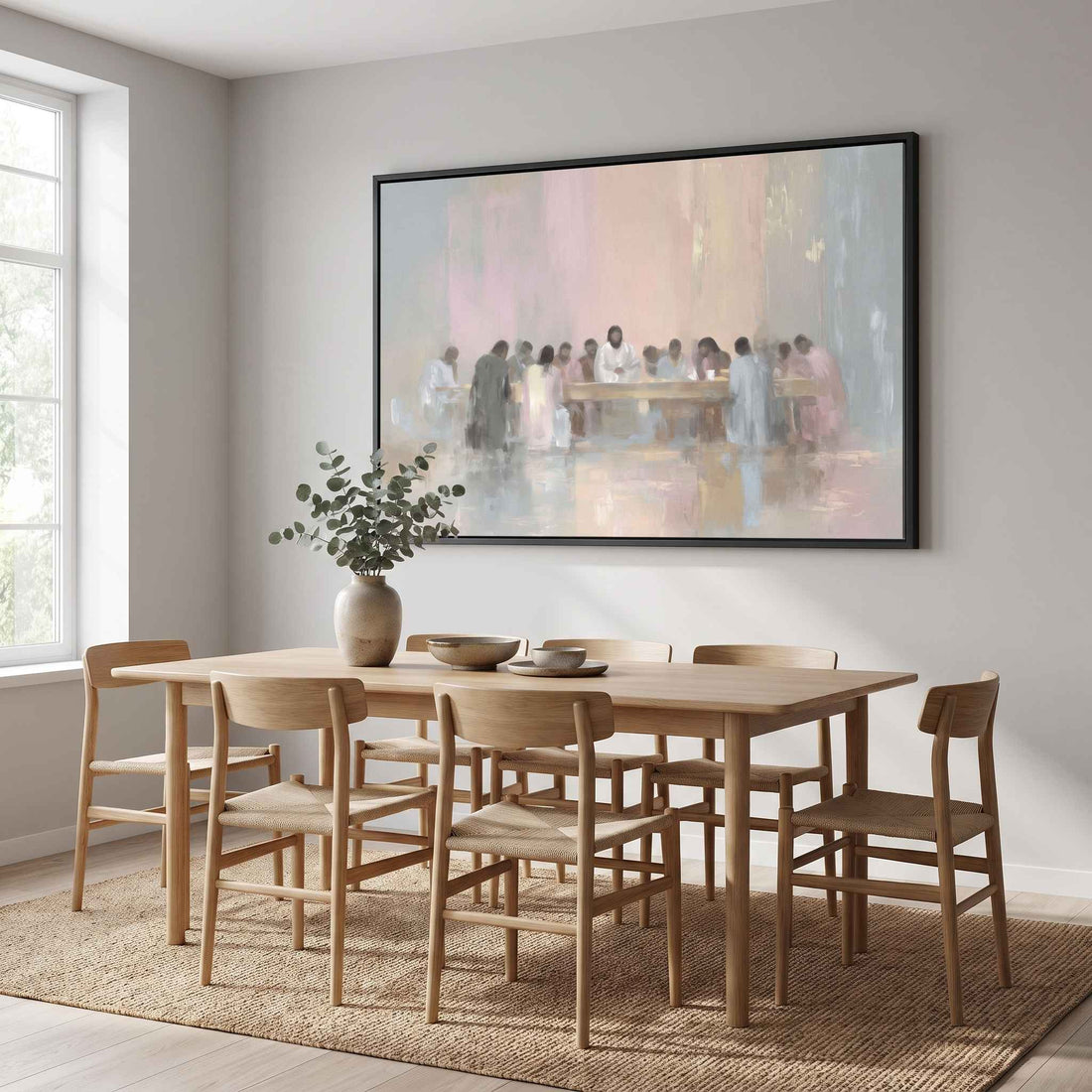
The Last Supper | Minimalist Christian Wall Art shows that restrained art need not use hard outlines. Pale washes and loosely defined figures gather around a table. Gray, cream, and muted pink allow the group to read without sharply describing every face or object.
In this Scandinavian-inspired dining room, the table and chairs bring repeated horizontal and vertical lines. The artwork adds a softer surface above them. A dark frame separates the pale picture from the light wall and connects with its deeper gray passages. Keeping the tabletop arrangement low allows the image to remain visible from across the room.
The subject also deserves attention beyond its decorating role. In Luke 22:14–20, Jesus shares the Passover meal with His apostles and speaks of His body given and blood poured out. This is an artistic interpretation of the event, not a reconstruction of the room. Its place near a family table can prompt a conversation about Christ, while keeping the historical meal and our own gatherings distinct.
Choosing the Right Piece: A Practical Check
Start with what you want to notice. A cross or dove registers quickly from across a room. A line drawing rewards closer looking. A Scripture print asks people to read. Choose the role before choosing the size.
Borrow one or two colors from the room. Sage can relate to foliage or a muted wall; ivory can echo upholstery. Avoid matching every cushion and accessory. If everything is similarly pale, a darker frame or clearer line drawing may give the arrangement a needed edge.
Test the proportions. Measure the usable wall, furniture, switches, and nearby openings. Tape up a paper outline, then look from the doorway and normal seating positions. A single vertical print may suit a narrow space beside a chair; a broad wall above a sofa may need a different orientation or a carefully planned group. Include gaps when measuring a group.
Compare the actual formats. The five featured listings currently offer Poster and Canvas, with unframed options and frame finishes including Maple Wood, Golden, Walnut, Black, and White. Check the combination and dimensions you select. Poster paper and canvas have different surfaces; neither turns the pictured lines or watercolor marks into original paint. Room mockups do not establish an exact size or guarantee a particular color match under your lighting.
For the broader questions of placement and meaning, see how to choose Christian wall art. Our modern Christian wall art guide compares the wider design direction. If you want stronger color or more gestural marks, compare the abstract Christian art collection; abstraction describes how forms are represented, while minimalism describes restraint. The two can overlap.
Questions About Minimalist Christian Décor
Can minimalist Christian art work with patterned furniture?
Yes. Give the art a simpler area of wall, and connect one of its colors with the room. A broad green field or spacious line drawing can sit comfortably near a patterned chair. Check the whole view from the doorway: the chair may be the focal point, with the artwork playing a supporting role.
Do I need a matching set?
No. One well-placed picture can be enough. If you combine works, repeat something specific—frame finish, background tone, or alignment—while allowing the subjects to differ. Check each listing for what is included; suggested pairings and multi-picture room arrangements should not be assumed to be a single bundled product.
What if I prefer Christian art without figures of Jesus?
You can choose Scripture typography or a symbolic cross design instead. Christian households differ in their convictions about religious images. Select something you can display with a clear conscience, and give a gift recipient the same consideration. No particular artistic style is required for Christian life at home.
A room can be thoughtfully furnished and still have books on the table and an unfinished day in progress. Art is one part of that setting. Lamb’s Love exists to share “The Story of God’s Love, Made Visible”; the artwork can invite looking and conversation, while Scripture, prayer, hospitality, and love for others remain the substance of Christian living. Explore the minimalist designs with a particular wall—and a meaningful subject—in mind.

