

A cream sofa, a square-edged wood coffee table, and a landscape of geese beside a pond: the room above does not need antique furniture for the picture to belong. The painting-style image gives the clean-lined setting something softer to look at. Its dark frame makes a clear boundary against the pale wall.
Vintage Christian art can work that way in a modern home. You might choose it for a biblical story, a passage of Scripture, or the way its light and color sit with your furniture. The useful question is what connects the two. In our vintage Christian wall art collection, pastoral scenes, flowers, and still-life subjects offer different answers. Here we look at five examples, from the pictured John 14:27 landscape to an open Bible beside a lamp.
Featured above: My Peace I Give to You. The room images in this article are styling mockups; use each listing’s selected dimensions and format to plan your own wall.
What Makes Christian Artwork Look Vintage?
Vintage-inspired Christian wall art uses visual qualities associated with older paintings—such as muted color, softly described distance, painterly marks, and traditional subjects—to present Christian themes in newly produced prints. Lamb’s Love’s featured works are not authenticated antiques. “Vintage” describes their character, not their age or provenance.
The effect comes from several choices working together. Olive, brown, cream, and gray-green can make a scene less sharply colored than a bright graphic print. Blended edges leave trees or hills less precisely defined. Small variations across sky, grass, or water suggest a painted surface. A wooden frame may strengthen the impression, but an elaborate frame is not required.
Nor does every vintage-inspired image need to be brown or dark. The pale blue sky and fine white flowers in The Father Cares for You feel airy. The Bible-and-lamp still life has broad blue-gray and cream areas. Both offer a painting-like treatment without imitating the same country landscape.
Keep the surface distinction clear: the marks and tonal variations are part of the printed image. Canvas has its own material texture, but pictured brushwork does not mean that the print has hand-applied paint or raised impasto.
The Traditions Behind the Look
Two broad artistic traditions help explain the appeal: pastoral landscape and narrative painting. Neither belongs exclusively to Christian art, and neither identifies a Lamb’s Love print as a reproduction of a historical masterpiece.
Pastoral imagery places rural life—fields, animals, trees, and human figures—within a composed landscape. For one historical example, the Metropolitan Museum of Art describes Claude Lorrain’s Pastoral Landscape: The Roman Campagna of about 1639 in terms of light in the distance and shadow nearer the viewer. Its rural world includes shepherd poets and musicians. That is a useful reminder that a pastoral scene is not automatically a biblical scene.
Christian narrative painting gives visible form to a story or theological subject. The National Gallery explains that history painting can take its subjects from the Bible as well as other sources; the category concerns narrative rather than documentary accuracy. Clothing, settings, gestures, and light are artistic decisions. A painting of Jesus among sheep can interpret His teaching without recording a particular moment witnessed in the Gospels.
These references give us a vocabulary for looking. They do not establish that a named historical artist directly influenced a particular product. For a wider comparison of painting-inspired, line-art, and other approaches, our Christian wall art styles guide is a helpful starting point.
Why an Older-Looking Image Can Work with Modern Furniture
A painting-style picture and a contemporary sofa do different visual jobs. The sofa may provide clear edges and a large plain surface; the picture introduces shifting color, depth, and a subject to explore. The difference can be useful. A room does not need every object to speak in the same style.
Look for a connection rather than a complete match. A dark frame might relate to a lamp or a few darker details in the image. Muted greens can sit alongside foliage, and cream highlights can connect with upholstery. If the painting is detailed, a simpler console and a small number of objects below it can help the subject remain legible.
“Modern traditional” and “transitional” are useful decorating descriptions for mixing familiar forms with simpler furnishings. They are not strict rules. You can borrow the same approach for a farmhouse bedroom or a contemporary apartment without changing the whole room.
Behind the Art: Four Ways to Bring Vintage Christian Art Home
1. Give a contemporary living room a pastoral focal point
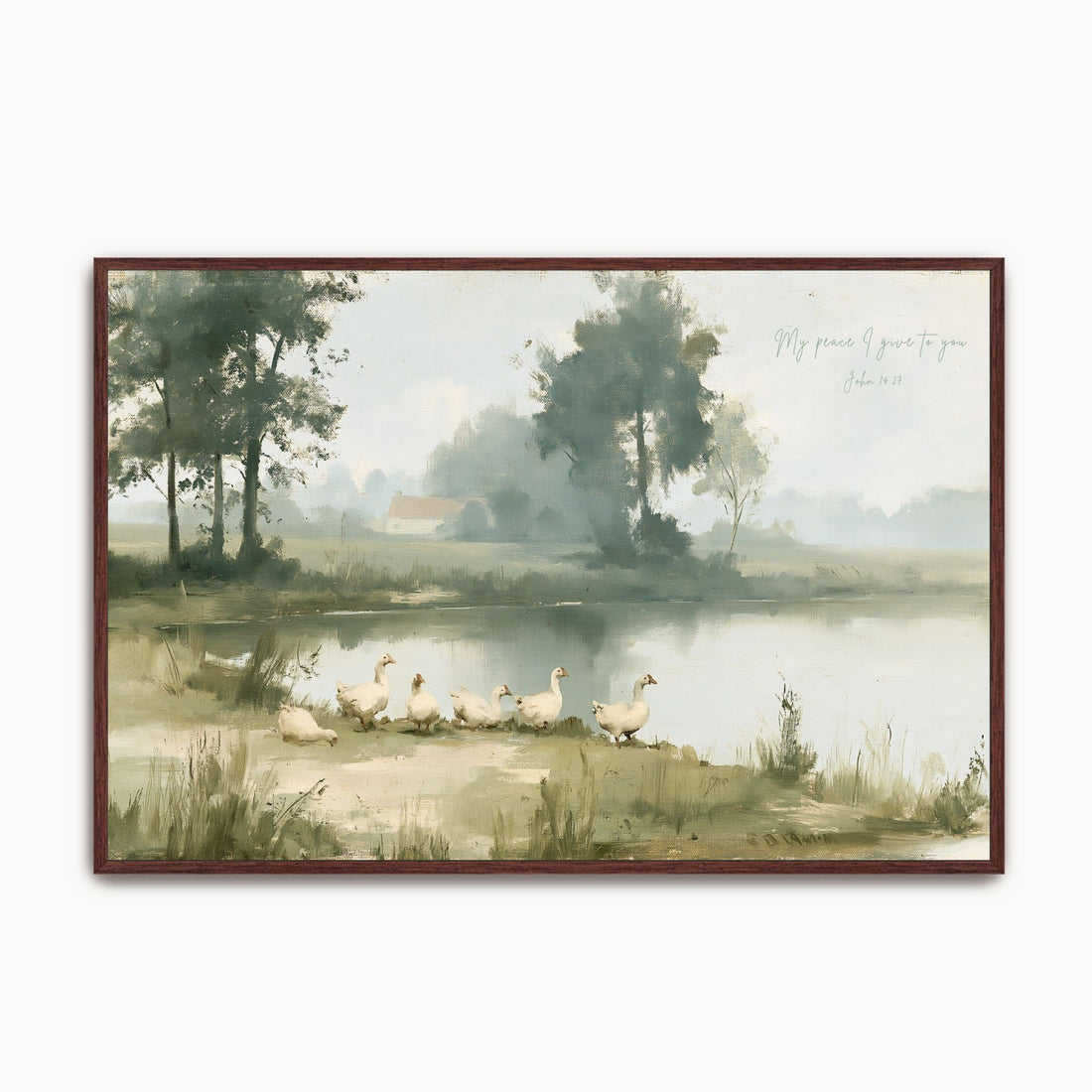
My Peace I Give to You has a small group of light geese along the bank, dark trees at the left, and paler forms beyond the water. The pond reflects the surrounding tones without becoming a hard-edged mirror. The restrained script occupies part of the light upper sky, leaving the landscape dominant.
In the living room shown at the top, the cream sofa and block-like coffee table are straightforward contemporary shapes. The painting introduces fine changes of tone above those broad surfaces. Its green-gray trees add color without requiring green furniture. The woven rug and dried stems relate to the rural subject through texture and natural forms, rather than by copying it.
The frame is especially useful here. Dark brown defines the edge of a pale scene against a pale wall. If your room already has dark window frames or a black floor lamp, a darker picture frame can join that rhythm; it need not match the coffee table.
John 14:27 gives the work its Christian connection. Jesus speaks to His disciples as His departure approaches, offering peace different from what the world gives. The tranquil pond is an artistic association, not the setting of that promise. Christ’s peace does not depend on our surroundings remaining tranquil. Read the words in their surrounding passage alongside the image.
2. Use a landscape to add depth above a simple entry console
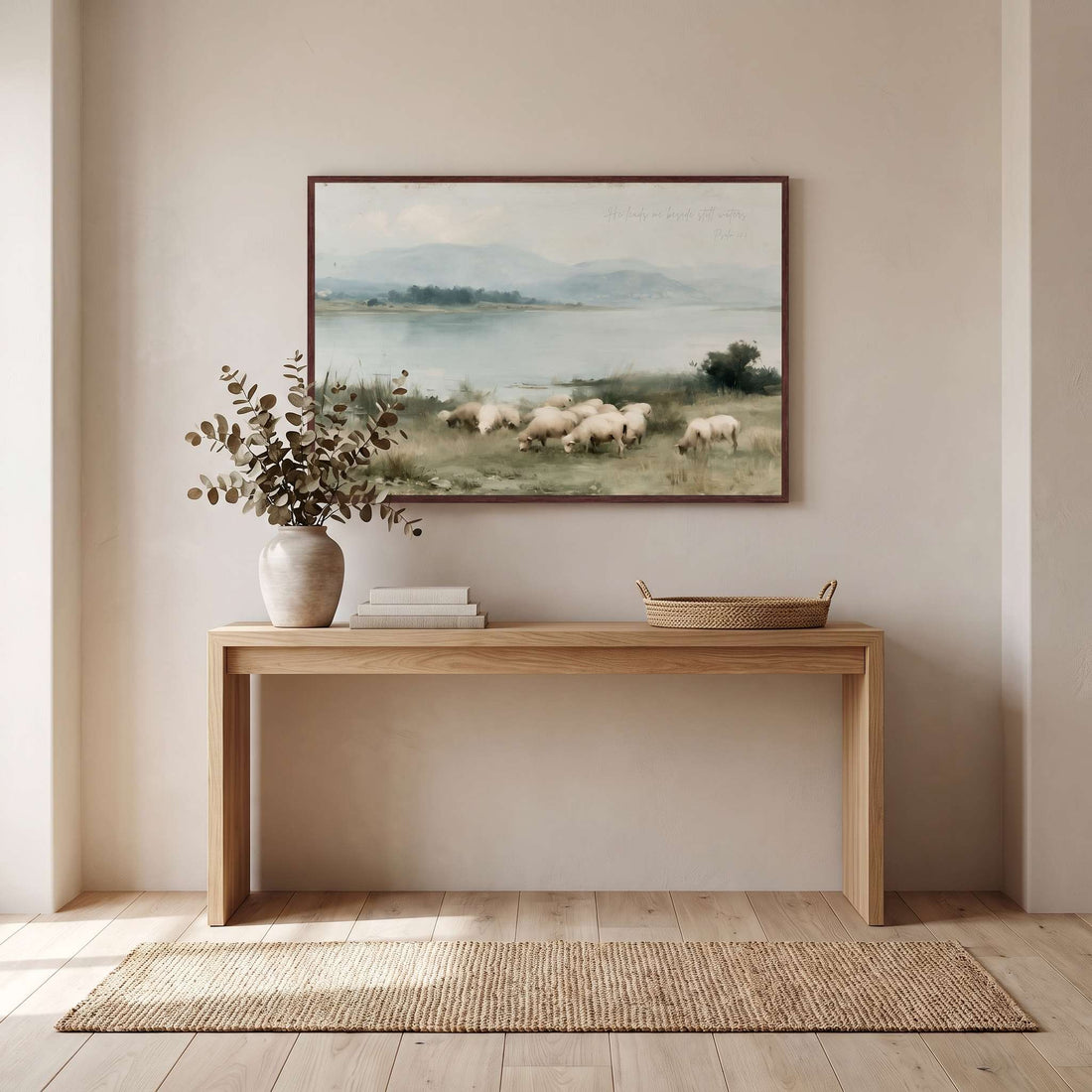
In He Leads Me Beside Still Waters, sheep occupy the nearer bank while a broad area of water and hazy hills open behind them. The horizontal arrangement suits the visual relationship with the console below. It offers a sense of distance on a shallow wall without adding more objects to the tabletop.
This is a workable transitional arrangement: a straight-lined wood console, a traditional-looking landscape, and a few useful accessories. The darker frame separates the picture from the wall; light wood keeps the furniture from becoming another heavy rectangle. A low tray leaves practical space for keys, while a taller vase balances it at one side.
In your own entryway, keep branches from covering the sheep or lettering. Check the view when the door is open and allow for switches and everyday traffic. The mockup helps explain an arrangement, but cannot tell you which print size fits your actual console.
The title draws on Psalm 23:2, while the psalm’s restoration language continues in verse 3. Its trust in the Lord includes both green pastures and the dark valley of verse 4. The scene selects the waterside image; it does not describe the full range of life under the Shepherd’s care. That distinction lets the beauty remain encouraging without making it unrealistic.
3. Balance painterly subjects with the structure of a bedroom
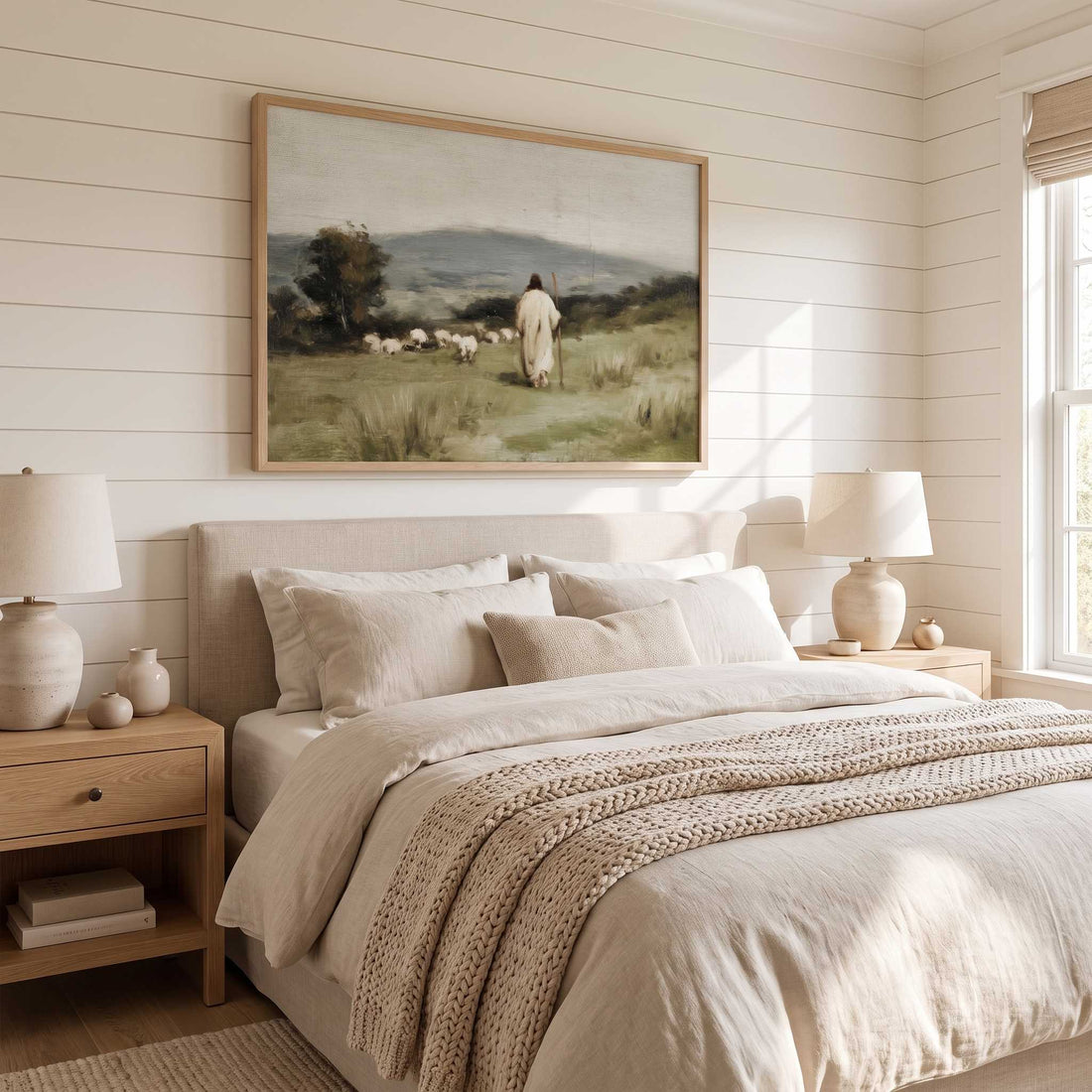
Following the Shepherd places a robed figure seen from behind within a field occupied by sheep. A dark tree mass at the left, lighter grass, and a distant ridge give the composition depth. The view leads outward across the landscape rather than presenting a close portrait.
The paneled bedroom pairs that subject with modern farmhouse elements: a simple upholstered headboard, pale wood nightstands, and white horizontal boards. Those repeated lines give the room structure. The softer hills and uneven foliage interrupt the repetition, while the light-toned frame relates to the bedside furniture.
John 10:4 connects following with knowing the Shepherd’s voice. Later in the chapter, Jesus speaks of laying down His life for His sheep and taking it up again. The gospel grounds discipleship in the Savior’s work, rather than our ability to make a room—or ourselves—look orderly. Our article on the Good Shepherd in Christian art explores that subject in greater depth.
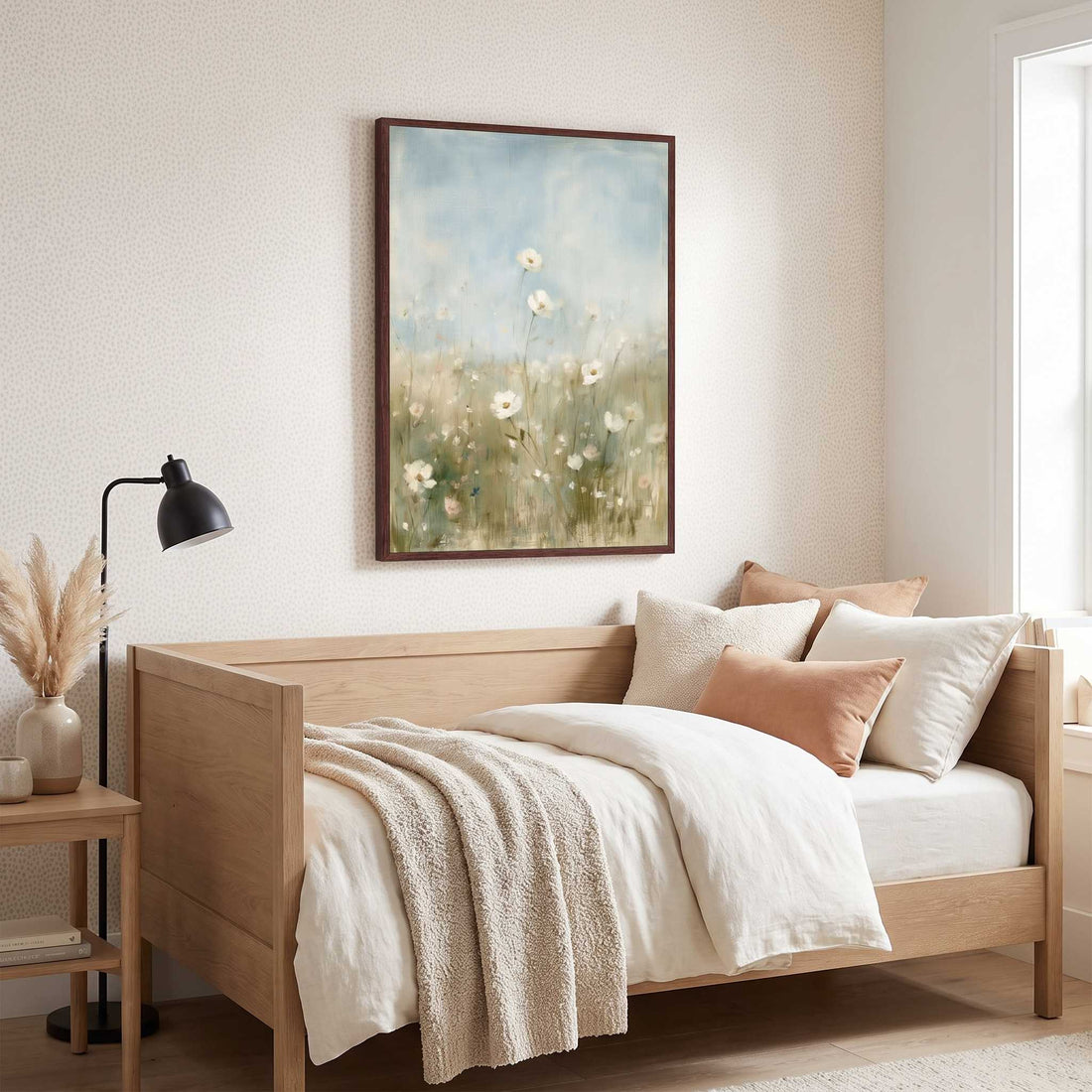
For a cottage-inspired guest room or daybed corner, The Father Cares for You offers another direction. Delicate white blossoms rise into a pale blue sky. Their fine stems and uneven heights keep the lower part active, while the sky leaves a more open area above.
In this room, tan cushions and the wood daybed connect with the warm field colors. The black task lamp and dark frame provide small, distinct accents against light bedding. The pairing does not need floral cushions or patterned wallpaper: the picture supplies the botanical detail.
The listing connects the flowers to Matthew 6:28–34. Jesus points to God’s care for growing things and calls His hearers to seek the Father’s kingdom and righteousness. The picture can invite a return to those words; neither the flowers nor the purchase promises relief from every worry.
4. Place a traditional still life beside contemporary work
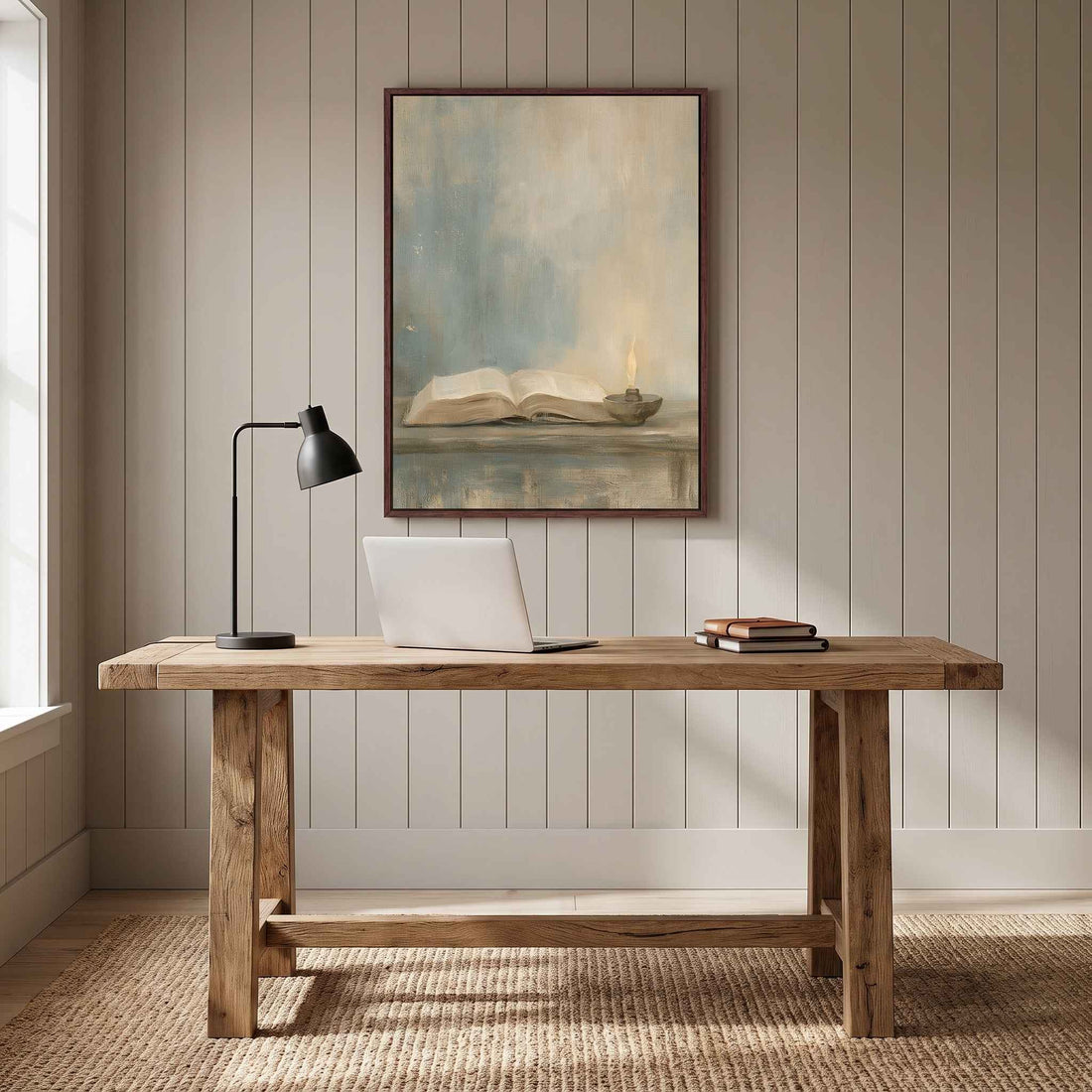
Your Word Is a Lamp to My Feet brings a still-life subject into a working home office. An open Bible and a small burning lamp sit low in the picture beneath a broad blue-gray and cream background. The warm flame provides a small concentration of light, rather than illuminating a crowded scene.
The desk mockup makes a particularly useful comparison. The pictured oil lamp and real black task lamp have different shapes and purposes, but both direct attention to reading. A laptop belongs in the setting without needing to imitate an antique writing desk. Rough-looking wood and vertical paneling supply lines and texture; the broad painted background keeps the arrangement from becoming too busy.
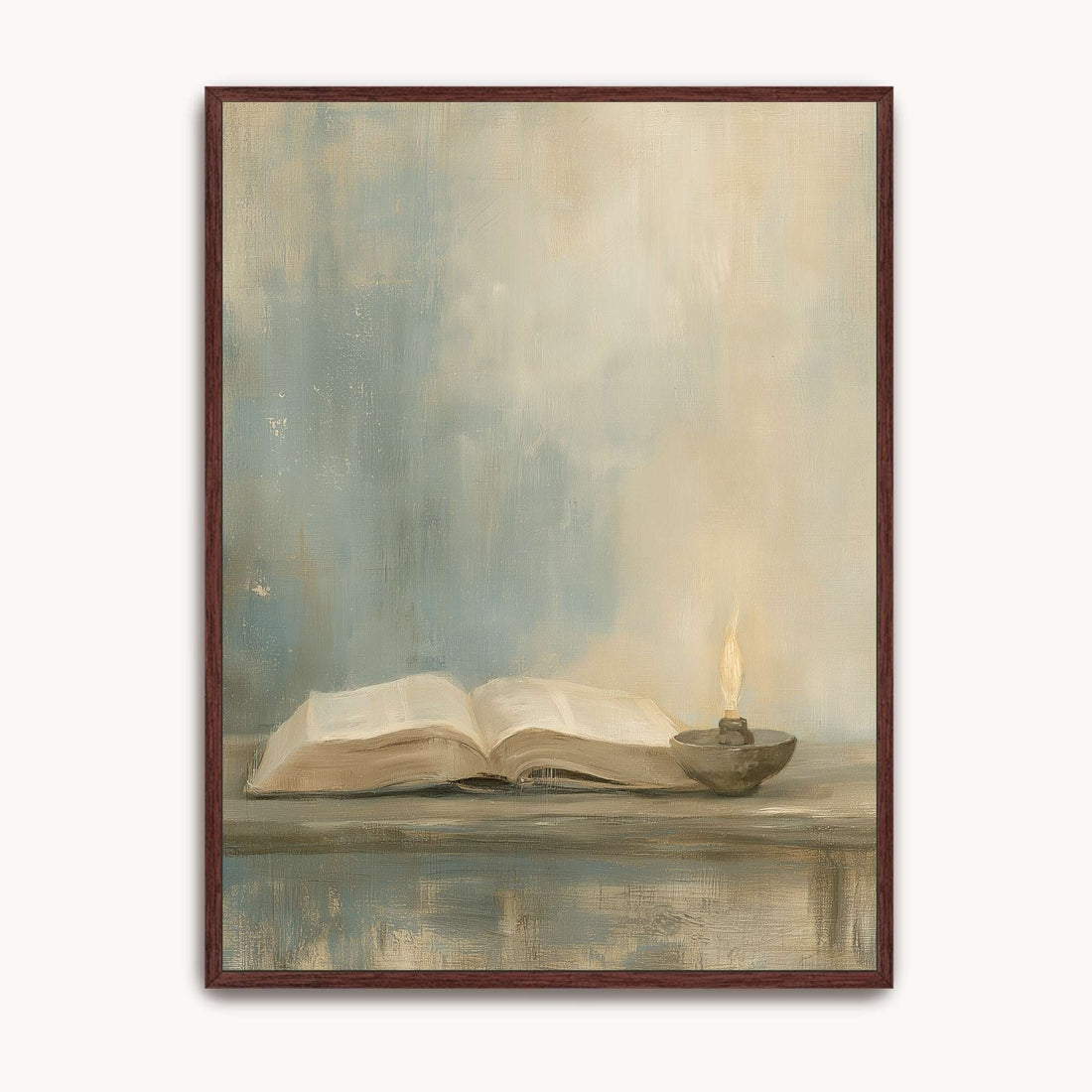
Psalm 119:105 compares God’s Word to a lamp and a light for the path. The surrounding verses speak of obedience and affliction as well as guidance. The open modern bound Bible is a visual interpretation of Scripture’s guidance, not a claim about the physical book used by the psalmist. Beside a desk or reading chair, the image can prompt an ordinary action: open the Bible and read.
Choosing a Frame, Size, and Place
Decide how much contrast the room needs. A dark frame gives a pale sky or floral subject a firm boundary. A lighter wood finish can connect a deeper landscape with pale furnishings. You do not need every wood finish to match, but repeating one tone elsewhere can help the arrangement feel connected.
Measure the relationship to the furniture. Check usable wall width, headboards, consoles, door openings, and lighting. Tape up a paper outline of the finished size and look from normal sitting and standing positions. Let a detailed image have some uninterrupted wall around it. If Scripture lettering matters to you, check its actual scale and contrast; fine script may be easier to read nearby than across a room.
Confirm the product, not the mockup. All five featured listings currently offer Poster and Canvas materials, unframed options, and frame finishes including Maple Wood, Golden, Walnut, Black, and White. Dimensions vary by artwork and selection. Check orientation and finished measurements rather than assuming every image is available in the same proportions. Follow the product’s care and mounting guidance and consider sunlight, moisture, and reflections at the intended spot.
If you prefer fewer marks and more open backgrounds, compare the minimalist Christian art collection. Vintage-inspired character and modern furniture are one combination among several; our modern Christian wall art guide gives the broader view.
Questions About Vintage Christian Art
Do I need antique furniture to display vintage-inspired religious art?
No. A simple sofa, desk, or console can give a detailed picture room to stand out. Begin with a shared color, a frame that relates to another finish, or a useful contrast between the image and furniture. You can keep the furnishings you enjoy and change only the arrangement around the artwork.
Is vintage-inspired Christian wall art an original oil painting?
Not necessarily, and these featured Lamb’s Love products are prints offered in poster and canvas formats. Their images have a painting-inspired appearance. That describes the visible style, not antique provenance, a named historical painter, or hand-applied oil paint. Read the selected listing for the material and framing included.
Can a quiet landscape communicate Christian meaning without printed Scripture?
Yes, when its title or description establishes a biblical connection. The passage helps distinguish an intended Christian theme from a viewer’s personal association. Do not assume every shepherd is Jesus or every flower has a fixed biblical meaning. Read the stated Scripture and notice how the image interprets it.
In the opening room, the pond scene works because it has something specific to contribute: a softer view above a simple sofa and words that lead back to Christ. That is a good place to begin your own choice. Look for a subject you want to live with, then consider the colors, framing, and space around it. Explore the vintage-inspired artwork at your own pace. Lamb’s Love’s mission is “The Story of God’s Love, Made Visible”—an invitation to look toward the story, while Christian life at home continues through Scripture, prayer, hospitality, and care for one another.

