

In Lamb’s Love’s The Nativity Scene, a small gathering occupies the lower part of the picture. Above them, a star shines through a broad, pale sky. The eye moves between that light and the child below. It is a familiar Christmas composition—and it already brings together details from two different Gospel accounts.
Nativity art tells the story of Jesus’ birth through choices about people, light, setting, and space. Some details come directly from Scripture. Others belong to Christian interpretation or artistic tradition. Learning the difference makes a painting more interesting to look at, and gives us a better way to explain it. This Behind the Art guide explores those distinctions through our Christian Christmas Wall Art collection.
What Does the Nativity Represent in Christianity?
The Nativity means the birth of Jesus Christ. Matthew and Luke give the narratives Christians turn to when telling that story. Luke 2:1–20 describes Bethlehem, the manger, an announcement to shepherds, and their visit. Matthew 1:18–25 focuses on Joseph’s response to God’s message, Jesus’ conception by the Holy Spirit, and His naming.
The significance reaches beyond the circumstances of a birth. John 1:14 says, “And the Word was made flesh, and dwelt among us.” (King James Version) John has already identified the Word as divine and present before creation. Christians call this the Incarnation: the eternal Son of God became truly human without ceasing to be God.
That is why the child matters more than the atmosphere around Him. A manger scene expresses humility, but the gospel does not stop at humility. Matthew 1:21 connects Jesus’ name with saving His people from their sins. His birth belongs to the story that leads to His death and resurrection, forgiveness, and reconciliation with God. Christian readings of Isaiah 9:6 likewise connect the promised child and royal titles with hope fulfilled in Christ.
What Does the Bible Actually Say—and What Comes from Artistic Tradition?
The Gospels give us a manger, shepherds, Magi, a star, and gifts. They do not give us one scene containing every familiar Christmas figure at the same moment. A painting can gather several parts of the story into a single view. That is a visual summary, rather than a precise timeline.
The manger is stated; the building’s design is not
Luke 2:7 says Mary wrapped Jesus and laid Him in a manger because there was no room for them in the lodging. A manger is a feeding place for animals. Luke does not describe its material, the room’s layout, or a freestanding wooden stable. Nor does he introduce an innkeeper who speaks to the family. Timber shelters, caves, and ruined buildings in paintings supply a setting that the text leaves undescribed.
The shepherds visit the manger; the Magi enter a house
Luke 2:16 names Mary, Joseph, and the infant lying in the manger when the shepherds arrive. Matthew 2:1–12 gives a different scene: visitors from the east, a star, and worship in a house, where they see the child with Mary. Matthew does not say that the Magi arrived on the night of the birth. We should not claim an exact interval that the passage does not supply.
Three gifts are named; three visitors are not
Matthew names gold, frankincense, and myrrh but never counts the Magi. The familiar group of three reflects tradition associated with those three gifts. Their names, crowns, and portrayal as kings are also later developments, rather than details Matthew provides. Camels are a recognizable artistic way to picture their journey; Matthew does not specify their transport.
Animals belong to the visual tradition, not a Gospel attendance list
The manger suggests an association with animals, but neither birth narrative tells us which animals were present. The ox and donkey became especially familiar in Christian imagery. The Fitzwilliam Museum explains their early appearance in Nativity art, including fourth-century sarcophagi, and their association with later readings of Old Testament passages such as Isaiah 1:3. Those connections are interpretations; they do not add animals to Luke’s account.
Halos, radiant infants, and December 25 require another distinction
Neither Matthew nor Luke describes a halo around the child or light coming from His body. Luke does describe divine glory shining around the shepherds when the angel appears—outside, before their visit. Artists can use a glow around Jesus to express who He is, but the two lights should not be treated as the same narrated detail. The Gospels also give no calendar date for His birth; December 25 belongs to the history of Christian celebration.
These distinctions need not spoil a beloved scene. They help us say, with care, “This comes from Luke,” “This comes from Matthew,” or “This is how the artwork brings the story together.” Appreciating an image and reading the text closely can go hand in hand.
The Meaning Behind Familiar Nativity Symbols
The manger: a humble setting and an identifying sign
In Luke, the manger is part of the sign by which the shepherds will recognize the child. Artists often place it near the center so our attention settles on Jesus. Its Christian meaning comes from the contrast between His identity and His humble circumstances. Elaborate straw, carved wood, or a particular shelter may help a composition, but Luke does not describe those features.
Mary and Joseph: people responding to God
Mary gives birth and cares for the child; Luke also describes her treasuring and pondering what has happened. Matthew shows Joseph obeying God’s instruction and naming Jesus. A painting may express reverence through inclined heads, folded hands, or stillness. Those poses interpret the scene. They should not be used to invent conversations, thoughts, or actions the Gospels do not record.
The shepherds and angels: news received and shared
Luke introduces shepherds working at night, then makes them hearers and witnesses of the announcement. They go to see, tell others, and return praising God. Their presence turns a private-looking family scene outward toward proclaimed good news. Angel wings and musical instruments are familiar visual conventions; Luke’s birth narrative describes the heavenly host praising God, but does not mention trumpets.
The star and the gifts: guidance toward worship
The Star of Bethlehem belongs to Matthew’s account of the Magi. Its place in the story is to direct attention toward Jesus, not to make the sky the subject of worship. Matthew does not identify its astronomical nature, and a painter’s pointed star is not a scientific diagram.
The gifts are biblical; their customary symbolic meanings are interpretive. Gold is often associated with kingship, frankincense with divinity and worship, and myrrh with mortality and burial. The Fitzwilliam Museum traces this interpretation to Irenaeus. Matthew itself lists the gifts without explaining them individually that way.
Light around Jesus: theology expressed in paint
A bright center against a dark background gives a viewer somewhere to look. In Christian art, it can also connect with John 1’s language of life and light. That theological connection is different from claiming that the newborn physically illuminated the room. Ask what the light does within the painting before treating it as a detail of the event.
How Artists Have Depicted the Nativity Through History
The familiar crowded stable developed over time. A study in the Yale ISM Review describes early images of the Magi approaching Mary and the child in Roman funerary art. It also discusses a late-fourth- or early-fifth-century relief with Jesus in a manger accompanied by an ox and donkey, without the full gathering familiar today. Early Christian artists did not all select the same moment or cast of figures.
Later medieval and Renaissance traditions developed different arrangements of the family, visitors, buildings, and light. One specific example helps more than a sweeping rule: the National Gallery’s The Adoration of the Shepherds, attributed to a follower of Jacopo Bassano and dated about 1600–25, sets the shelter within classical ruins and makes Christ a source of light. The Gallery’s commentary explains those choices, including the influence of Saint Bridget’s writings on the light motif.
A contemporary line drawing may remove nearly all that scenery. A watercolor may leave the surrounding faces indistinct. These are different ways of directing attention, not successive improvements on the biblical story. No painting can contain everything the Gospels say.
The Nativity Through Lamb’s Love Artwork
Our mission, “The Story of God’s Love, Made Visible,” makes the relationship between story and image worth examining closely. These five designs offer different views of Christmas. Each is an interpretation to look at alongside Scripture.
A gathering beneath the star
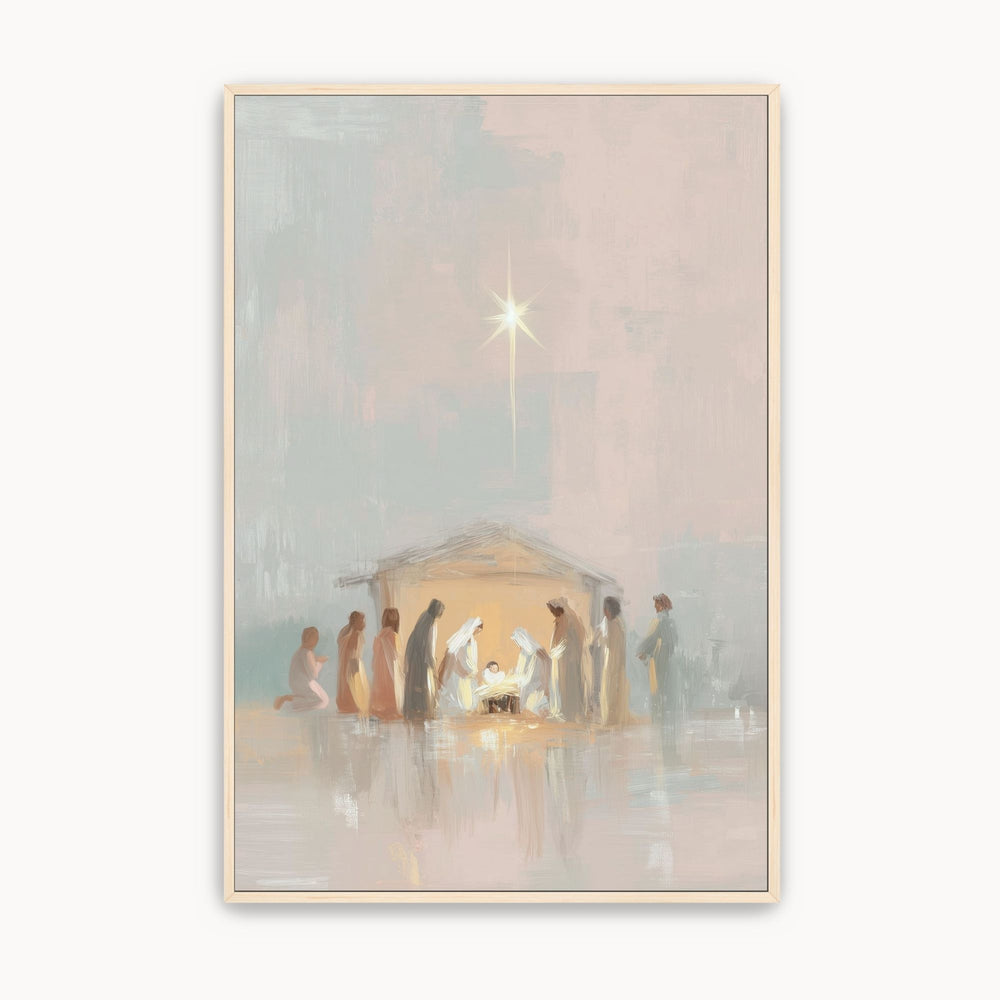
In The Nativity Scene, the small gathering and shelter sit low in a field of pale color. A star above them creates a second focus, linking sky and child. The combination draws Luke’s manger imagery and Matthew’s star into one composition. The loosely painted figures encourage us to look at their shared attention without pretending every person can be identified from the Gospel text.
The child and the open space
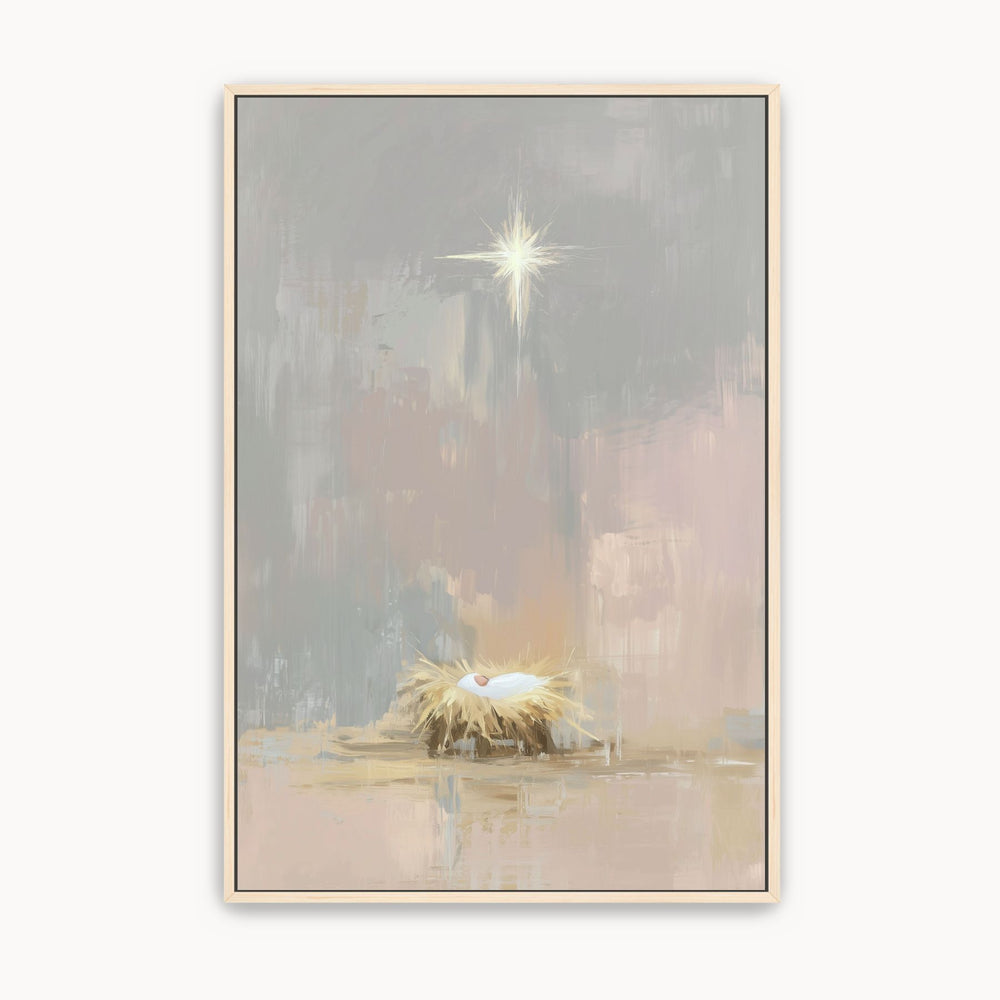
Baby Jesus in the Manger leaves out the gathered adults. White wrapping and straw give the lower part of the image its detail; a star occupies the space above. Its limited palette and large open areas keep the infant in view. Again, the star and manger bring the two Gospel narratives together. The composition is a concentrated Christian meditation, rather than an illustration of every detail Luke records.
The journey toward the child
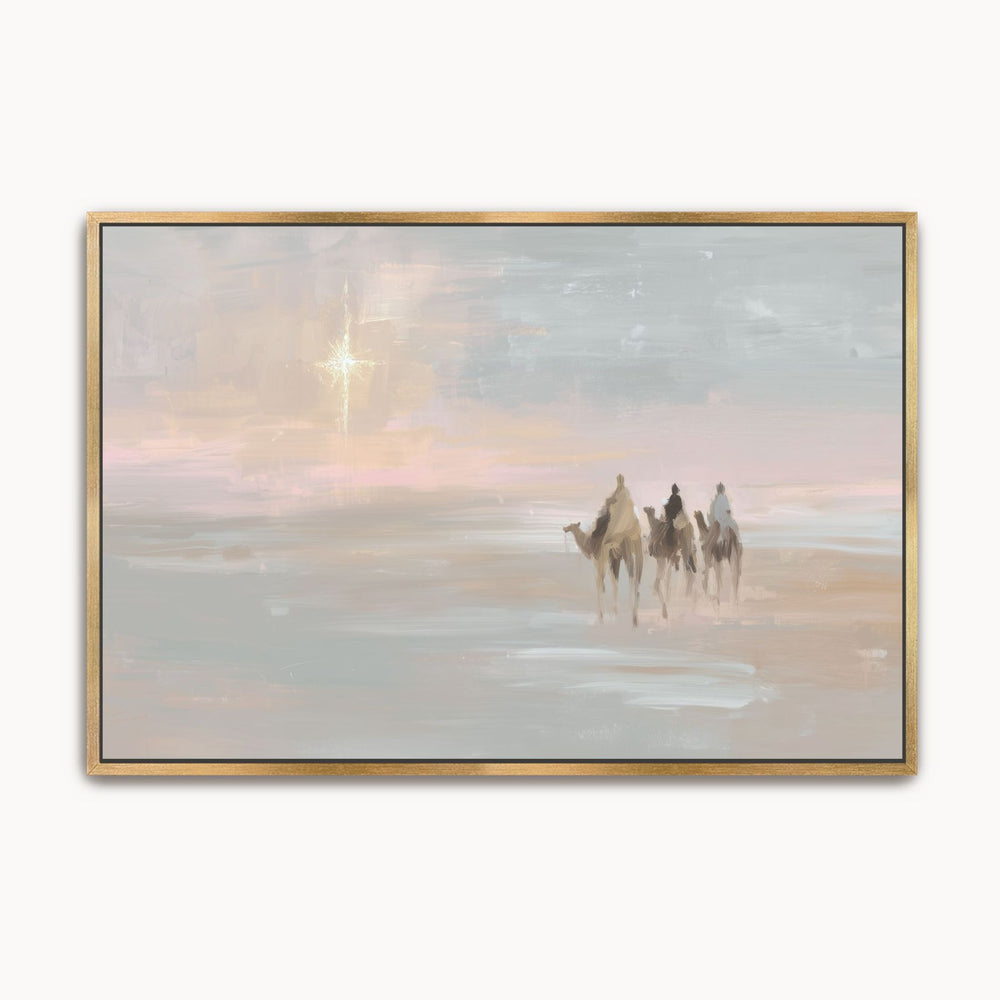
Three Wise Men and Star of Bethlehem places three mounted travelers toward one side of a broad horizontal landscape. Pale sand and muted blue-gray colors leave room between the riders and the star. The number three and the camels belong to the familiar visual tradition. Matthew supplies the visitors’ purpose: they have come to worship Jesus. The picture concentrates on their journey before that encounter.
A family group in line and shape
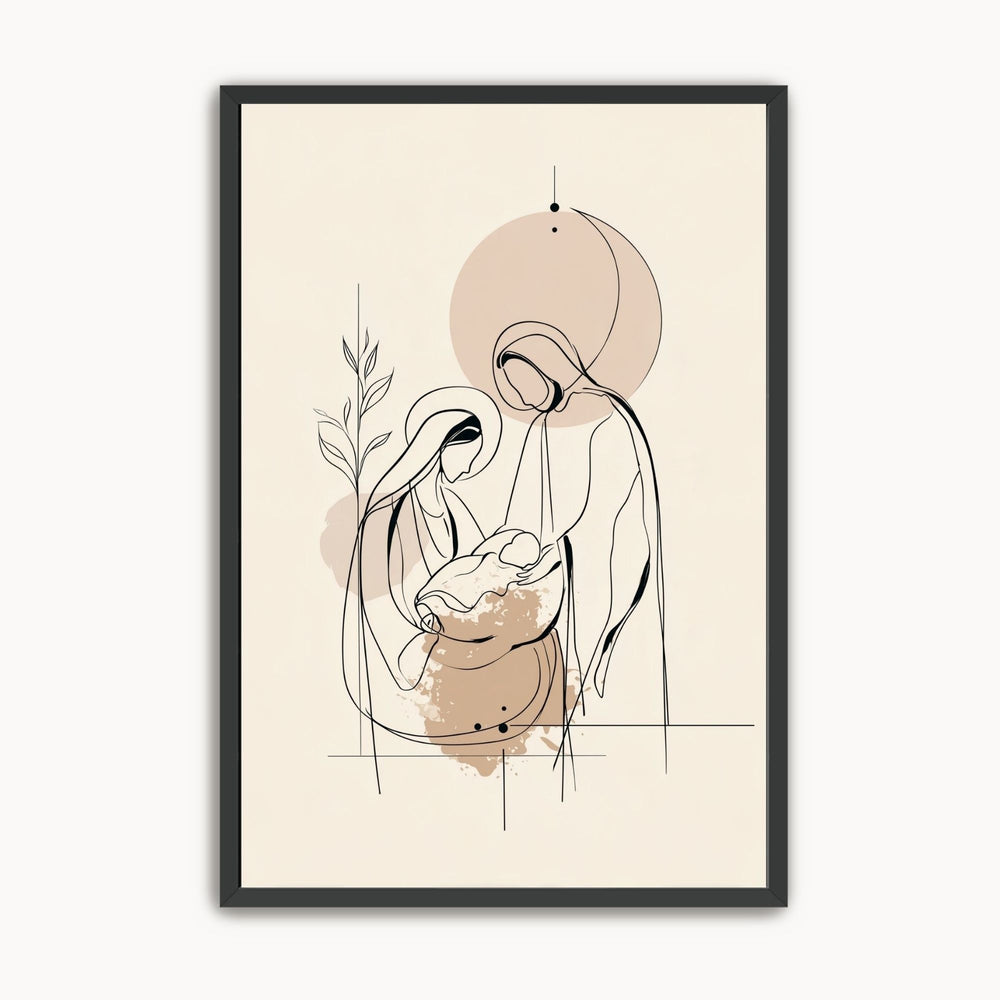
Minimalist Birth of Jesus moves close to the family. Black outlines describe Mary holding the infant beside Joseph, with beige forms behind them and a small botanical detail at the side. There is no elaborate landscape to explore. The modern shapes are design elements, not a code of biblical symbols we need to decode. The family grouping carries the subject.
Bethlehem viewed from a distance
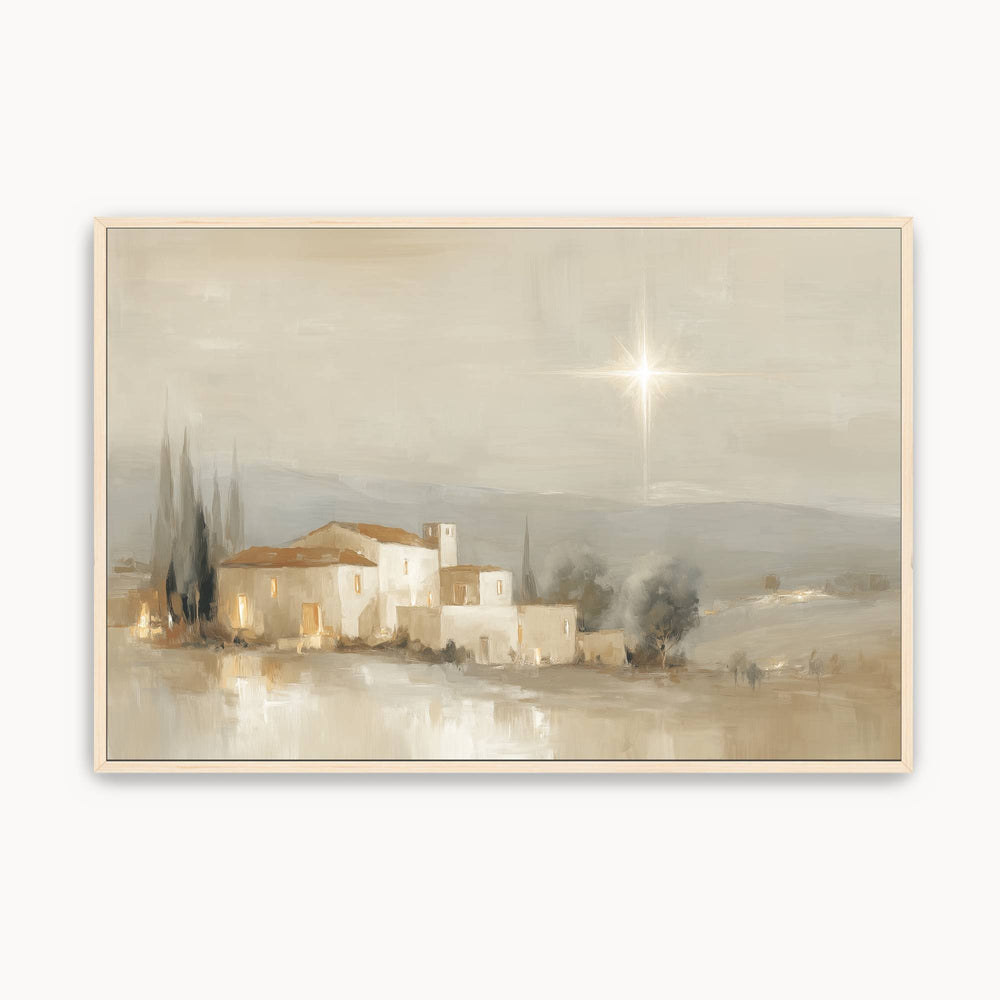
The Star Over Bethlehem gives the town more space than the people. Pale buildings, slender dark trees, and distant hills spread across the horizontal scene beneath a bright star. The warm vintage treatment differs from the close line drawing. It imagines a setting for the story without claiming to reconstruct Bethlehem’s architecture or the star’s appearance.
Choosing Nativity Art for Your Home
Choose the view you want to return to. The close family grouping of Minimalist Birth of Jesus suits someone drawn to simple outlines and neutral colors. A horizontal town or Magi scene gives the eye farther to travel and may relate naturally to a sideboard or sofa. Measure the actual wall; room mockups show styling possibilities rather than scale drawings.
Watercolor softness and vintage-inspired scenery can both work as seasonal displays. They can also remain throughout the year if you want to keep the Incarnation in view. Nativity art does not have to match a December color scheme. Our Christian wall art styles guide helps compare visual approaches.
Check each listing’s Poster or Canvas material, framing choices, orientation, and finished size. For a present, ask what the recipient would enjoy before choosing a large piece; the Christmas Christian wall art gift guide covers those practical decisions. Browse the complete Christian Christmas Wall Art collection to compare the actual designs.
Frequently Asked Questions About Nativity Art
What is the difference between a Nativity and an Adoration?
Nativity refers to Christ’s birth. An Adoration emphasizes people responding to Him in worship, commonly the shepherds or the Magi. Artists sometimes combine these subjects. A title helps identify a picture’s focus, but looking at the figures and reading the associated Gospel passage gives a clearer understanding of the scene.
Does a Nativity painting need to include every familiar figure?
No. A painting may focus on the child, the family, the shepherds, or the Magi’s journey. Leaving out a figure can give another part of the story more attention. What matters is understanding the selection and avoiding the assumption that the picture shows everything that happened, all at once.
How can I explain Nativity imagery to children?
Ask what they notice, then read a short part of Luke 2 or Matthew 2 together. Let them distinguish something the passage names from something the picture adds. You do not need to dismiss the added detail; explain that artists make choices when telling stories visually. Our guide to Christian artwork in children’s spaces offers more family ideas.
Are watercolor and vintage-style prints original historical paintings?
Those terms describe the design’s appearance. The Lamb’s Love works featured here are offered as prints in the formats listed on their product pages. Vintage-inspired styling does not make a print an antique, and a watercolor appearance does not mean the purchased piece is an original work painted on watercolor paper.
The center of Nativity art is a person: Jesus Christ, the Son who came among us to save. Artists give that confession different visible forms, from a small child in open space to a gathering beneath a star. Looking carefully can deepen our appreciation of the image while leading us back to the Gospel story it seeks to tell.

