

A stuffed animal has a place on the bed. Picture books lean in a basket, and last week’s drawing is waiting to be hung. A child’s room holds things they enjoy—and pictures that give the family something to talk about.
Christian artwork can join that collection. A child might notice the people gathered around Jesus or wonder why a shepherd stands beside a lamb. The opening is small: a question, a few words, perhaps a Bible story read together. Its value lies in the attention you share.
This look behind five works in Lamb’s Love’s Christian Nursery & Kids collection explores their biblical connections, the choices made in their illustrations, and ways they can belong in a room a child actually uses. You can apply the same ideas to a Bible illustration or a drawing you already own.
Featured above: Jesus with Children in a child’s bedroom mockup. The room images illustrate styling, not exact product scale or installation instructions.
Why the Pictures in a Child’s Room Matter
A familiar image can give parents and children a shared subject for noticing, remembering, and asking questions. It becomes useful through engagement: naming what is visible, explaining a story, listening to a child, or returning to Scripture. A picture cannot produce faith or character by being present on a wall.
Harvard’s Center on the Developing Child describes responsive back-and-forth interaction as important for early language and social development. The emphasis is the caring adult’s response to the child. This research does not test Christian wall art or establish spiritual outcomes from décor.
The American Academy of Pediatrics also encourages parents sharing books with preschoolers to talk about the pictures and respond to children’s questions. A wall picture offers a different setting for a similar practical approach: look together and follow the child’s interest. If they notice only a bird today, you can begin with the bird.
Making Room for Another Story
Superheroes, sports, dinosaurs, favorite characters, and imaginative play can all have a place in childhood. Adding Christian art need not mean removing what your child loves. It can make room for subjects you also hope will become familiar: Jesus receiving children, the Creator’s care, forgiveness, and love expressed through ordinary choices.
The wider story matters. Christian faith concerns the God who made us, our need for His grace, Jesus Christ’s death and resurrection, and life in Him through the Spirit. A gentle animal or a word about kindness can introduce part of that story; it cannot tell the whole of it. Parents bring the explanation and live alongside the questions.
Faith in Everyday Rooms and Routines
In Deuteronomy 6:4–9, God’s words are to be on His people’s hearts and taught amid daily life—at home, on the way, lying down, and getting up. The passage calls for love, instruction, and remembrance; it does not require purchasing decorations.
Psalm 78:4–7 similarly speaks of telling the next generation God’s works so that they put their hope in Him. Ephesians 6:4 joins Christian instruction with a warning against provoking children. That gives parents a relational responsibility, not a demand for a flawless room or polished answers from a tired child.
Images can accompany reading, prayer, and conversation as visual reminders. They are not objects to worship or substitutes for Scripture, church, and loving relationships. Our guide to a worshipful home considers that wider setting.
Five Artworks, Five Biblical Themes to Explore
Jesus welcomes children: belonging and grace
In Jesus with Children, a broad tree shelters a small gathering around Jesus. Pale pink, gray-green, and cream soften the scene; the people remain the subject without every face or leaf being sharply defined. It offers an approachable group to notice, rather than a wall full of instructions.
Mark 10:13–16 describes people bringing children to Jesus, the disciples’ attempt to stop them, and Jesus receiving and blessing them. The tree and arrangement are the artist’s interpretation, not details supplied by Mark. Try asking, “Who is close to Jesus? What does the Bible tell us He did for the children?” His welcome gives us something to discuss before asking anything about a child’s behavior.
The Good Shepherd: being known and cared for
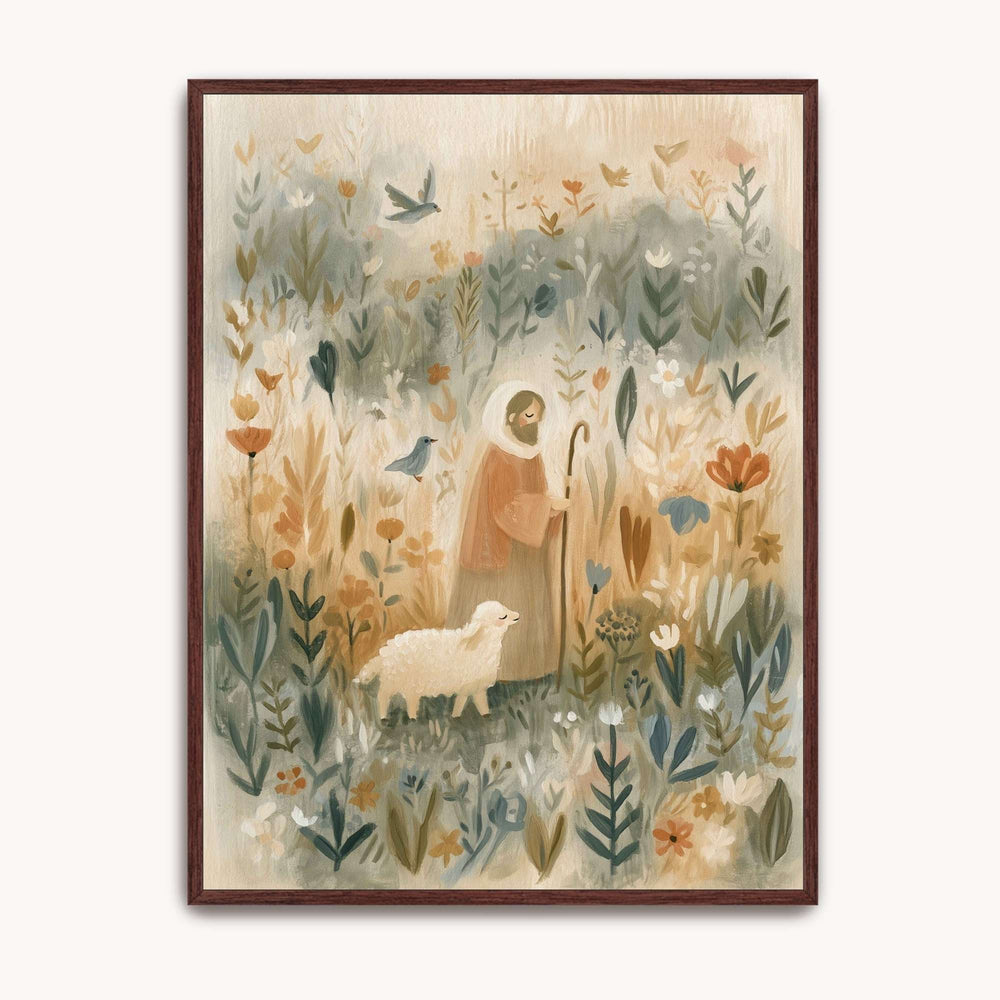
My Shepherd places Jesus and a white lamb among tall, patterned plants and birds. Their scale is imaginative: the surrounding stems make a garden-like world rather than a naturalistic reconstruction. A child might first notice the lamb, then the staff, then a bird they missed before.
John 10:11–18 identifies Jesus as the Good Shepherd who knows His sheep, lays down His life, and takes it up again. That sacrificial love gives the image its Christian meaning. Ask, “What might a lamb need from its shepherd?” Then read what Jesus says about Himself. His care does not mean children will never face pain or fear. Our Good Shepherd art article develops the subject further.
The fruit of the Spirit: grace and everyday choices
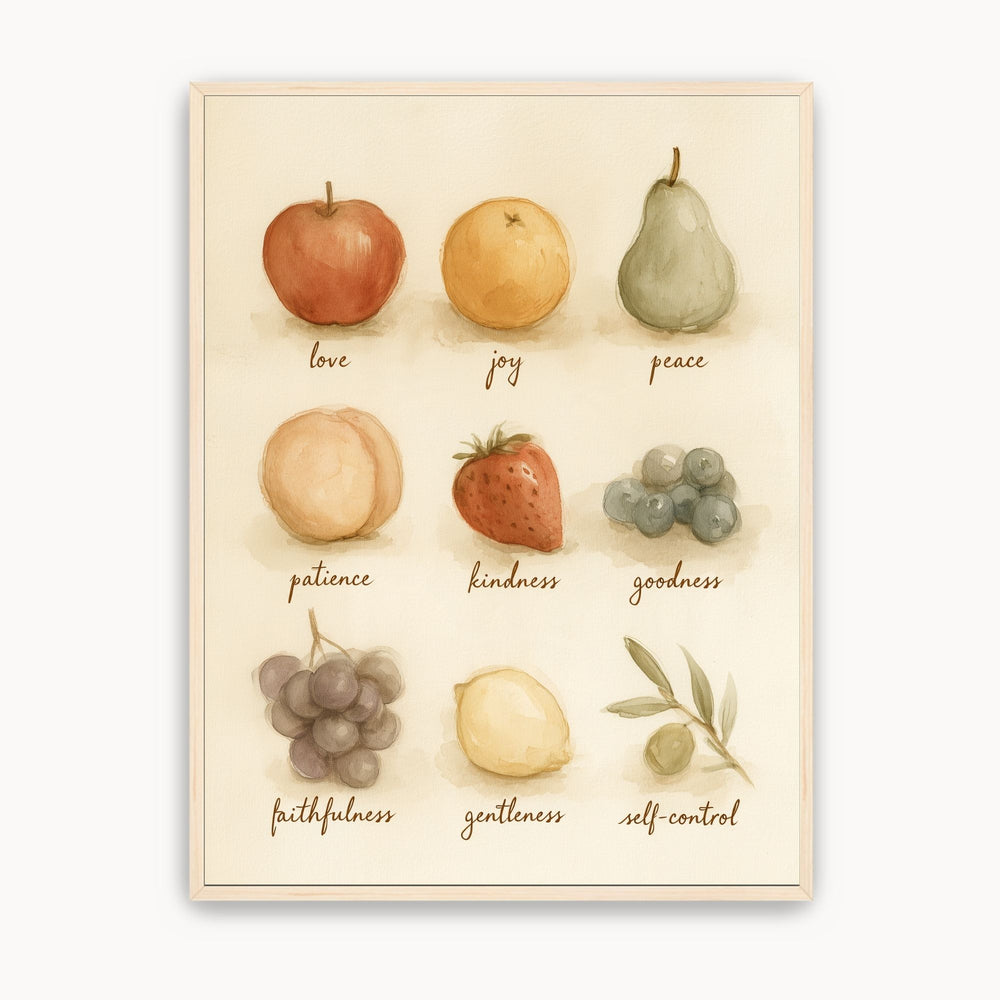
Fruit of the Spirit arranges nine fruit illustrations in three rows. Warm red, yellow, green, and purple make a change from an entirely neutral room. The repeated spacing lets each word have its own place.
Galatians 5:22–23 names the character the Spirit produces in believers. It does not assign kindness to a strawberry or self-control to an olive; those pairings belong to the illustration. You could ask, “How could we include someone who has been left out of a game?” Keep the response connected to grace and the Spirit’s help. The print is not a scorecard for earning God’s or a parent’s love.
Wonderfully made: human worth and the Creator’s care
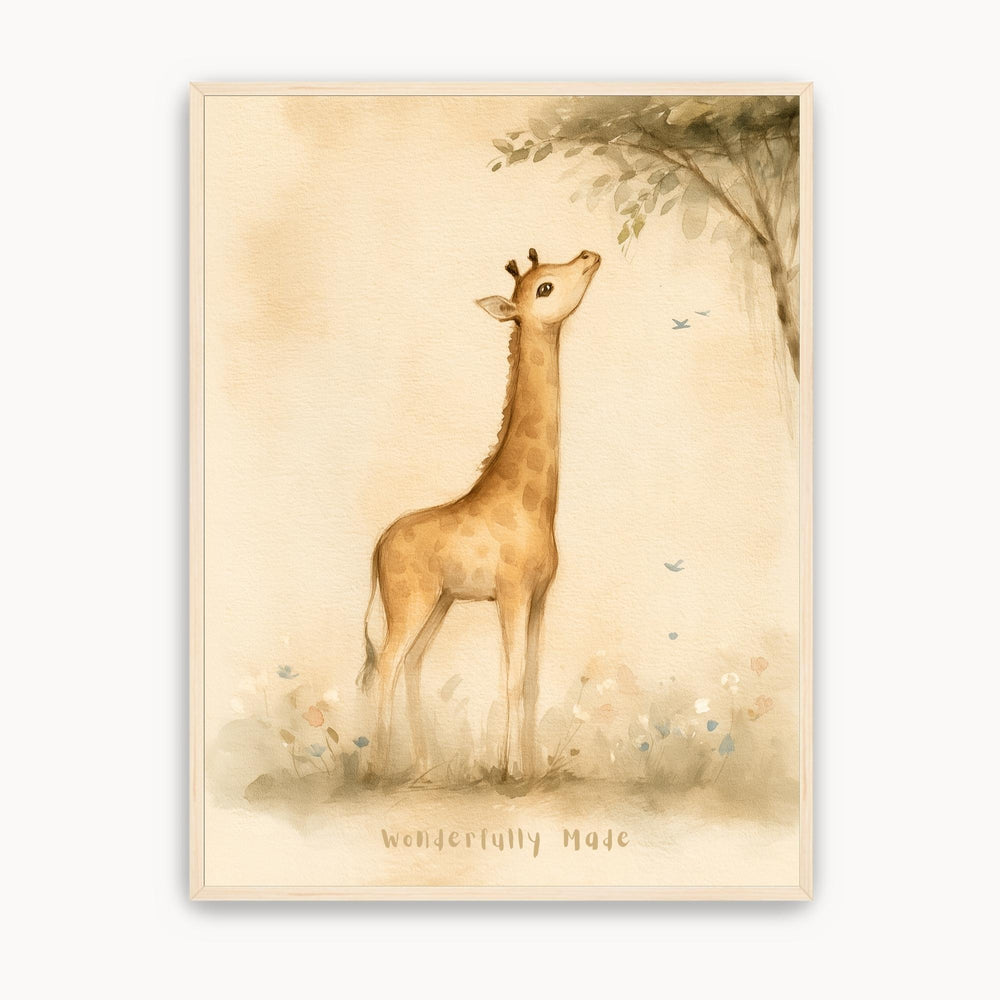
In Wonderfully Made, the calf’s lifted head directs attention toward the leaves above. A pale background separates the giraffe’s outline from small flowers and birds. It gives an animal-loving child a familiar subject to explore.
The listing connects it to Psalm 139:14. The surrounding verses concern the psalmist’s human life, known by God even before birth; they are not a description of a giraffe. Use the animal as an invitation to wonder, then read about God’s knowledge of us. “How can we care for people whose bodies or abilities are different from ours?” is one question worth returning to. Human worth does not depend on beauty, achievement, or ease of development.
Never alone: courage that includes asking for help
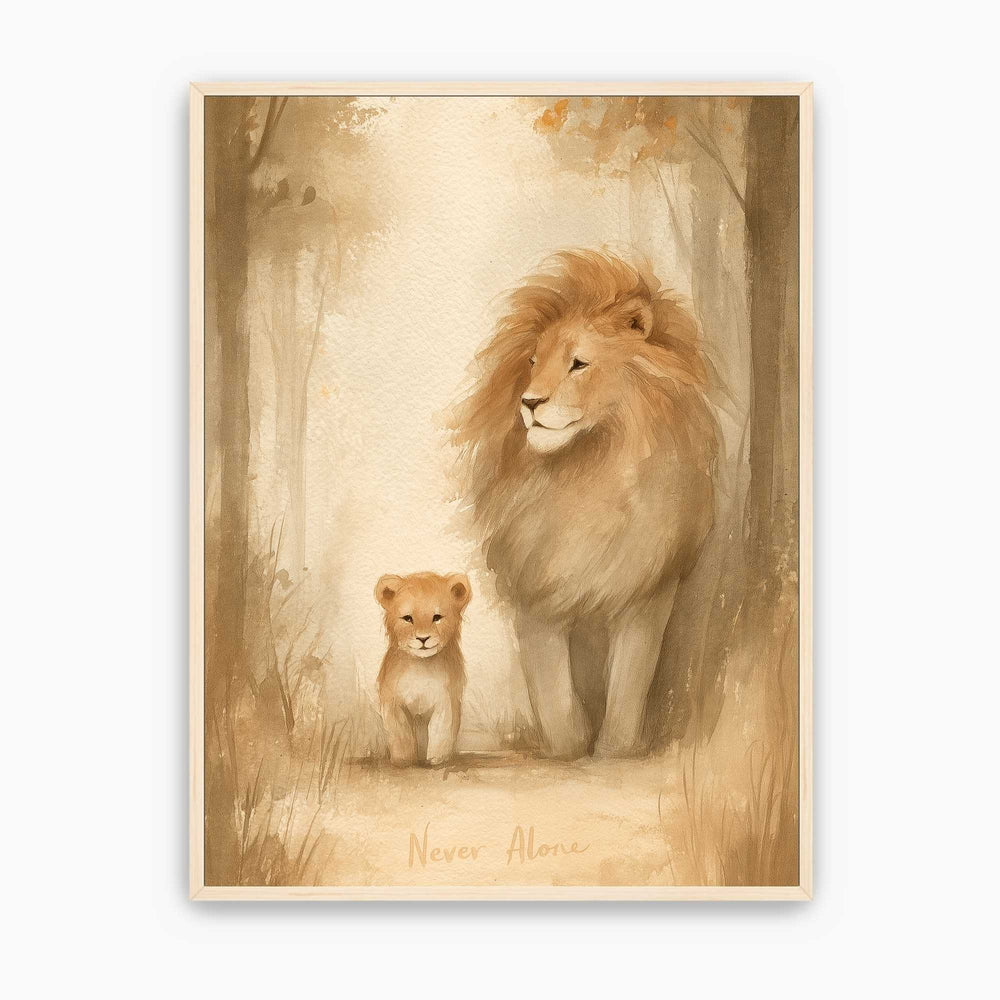
Never Alone gives the cub a place beside a much larger lion, framed by trees and light. Their size difference is especially noticeable against the soft background. The listing uses that relationship as a picture of strength and care.
Its Isaiah 41:10 connection needs context. In Isaiah 41:8–13, God addresses Israel, His chosen servant, with reassurance of His presence and help. The lions are a symbolic illustration, not part of the passage. Parents can talk about trusting God when afraid without promising a trouble-free day. Ask, “Who can you tell when something scares you?” Prayer and seeking help from a parent or another trusted adult can belong together.
Different Ages, Different Ways of Looking
Babies: choose art caregivers enjoy and place it safely away from the sleep space. Name a visible animal or color while holding your baby and respond to their attention. Do not expect a baby to understand a theological symbol.
Toddlers and preschoolers: begin with concrete subjects and short explanations. A child may point to the lamb rather than answer aloud. Pictures of Jesus with children offer people to identify; imaginative animals can prompt a question about care. Leave room for silence, pointing, play, or drawing.
Early elementary children: invite them to connect a picture with a few verses and a familiar situation. With fruit imagery, explain that Paul is talking about character rather than food. Read a label together, but do not make reading ability a test of spiritual understanding.
Older children: ask what they enjoy visually and what questions the image raises. Compare the artwork with the passage: what is stated, and what has the artist imagined? A less childlike landscape or Scripture design may suit their developing taste. These are flexible starting points, not milestones every child must meet on schedule.
Designing a Room with Space for Looking, Reading, and Play
Let the picture connect with the room without controlling it
The bedroom at the top uses soft bedding, a woven headboard, and pale wood around Jesus with Children. The image’s pink and gray-green tones relate to those gentle surfaces. A toy vehicle and books still have a place. That is a useful model for a watercolor room: repeat one or two colors and allow other belongings to remain themselves.
In a warm neutral nursery, a cream background and wood frame can relate to existing furniture. Botanical imagery can connect with a sage wall. Scandinavian- or Japandi-inspired restraint leaves room around a picture; it can still accommodate bright toys and children’s own drawings.
Use storage to keep the image visible and the room usable
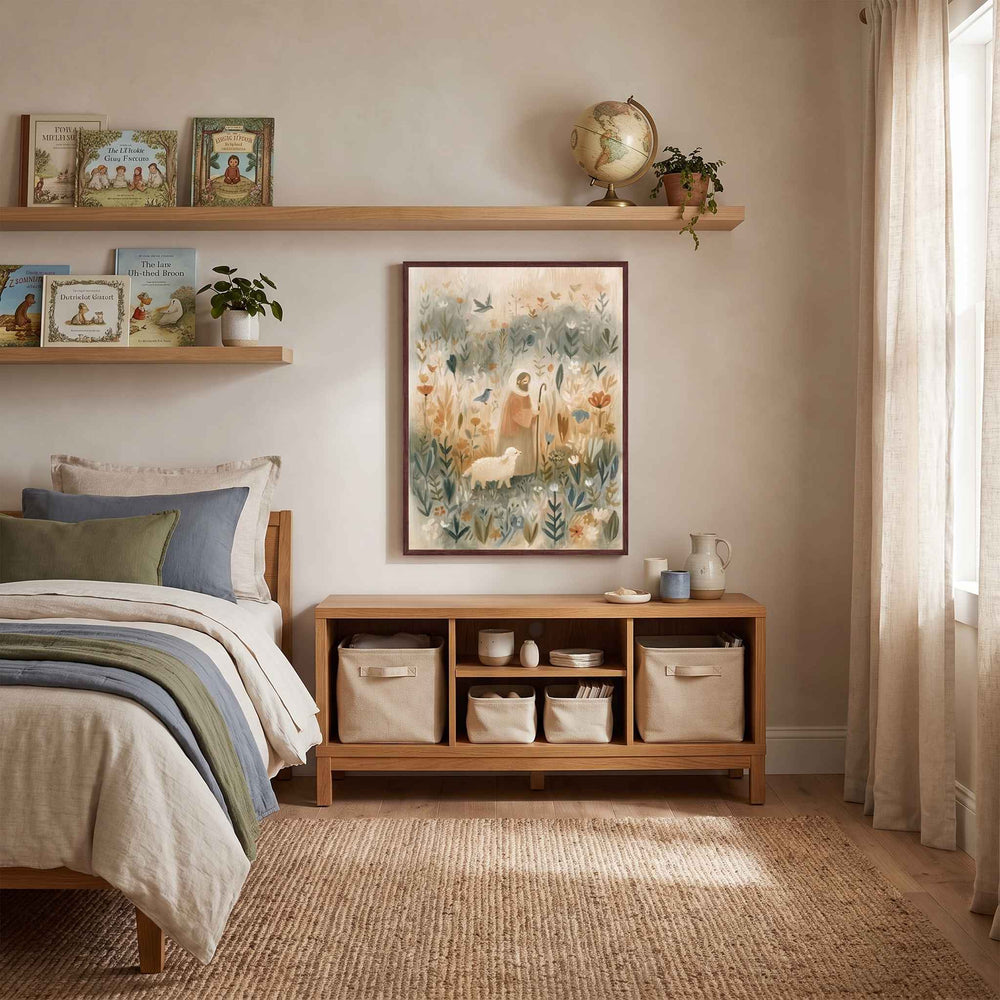
Here, My Shepherd sits above low cubbies rather than over the pillow. The darker frame gives its pale illustration a boundary, and muted greens relate to the bed’s cushions. Storage baskets make room for everyday belongings. Treat the shelf arrangement as an illustration, and plan secure mounting, furniture anchoring, and access for your own child.
A shared playroom can use one clear area for art, accessible books and toys, and somewhere for children’s work. Moving an existing picture near the reading area may be enough.
Make a reading or learning corner comfortable
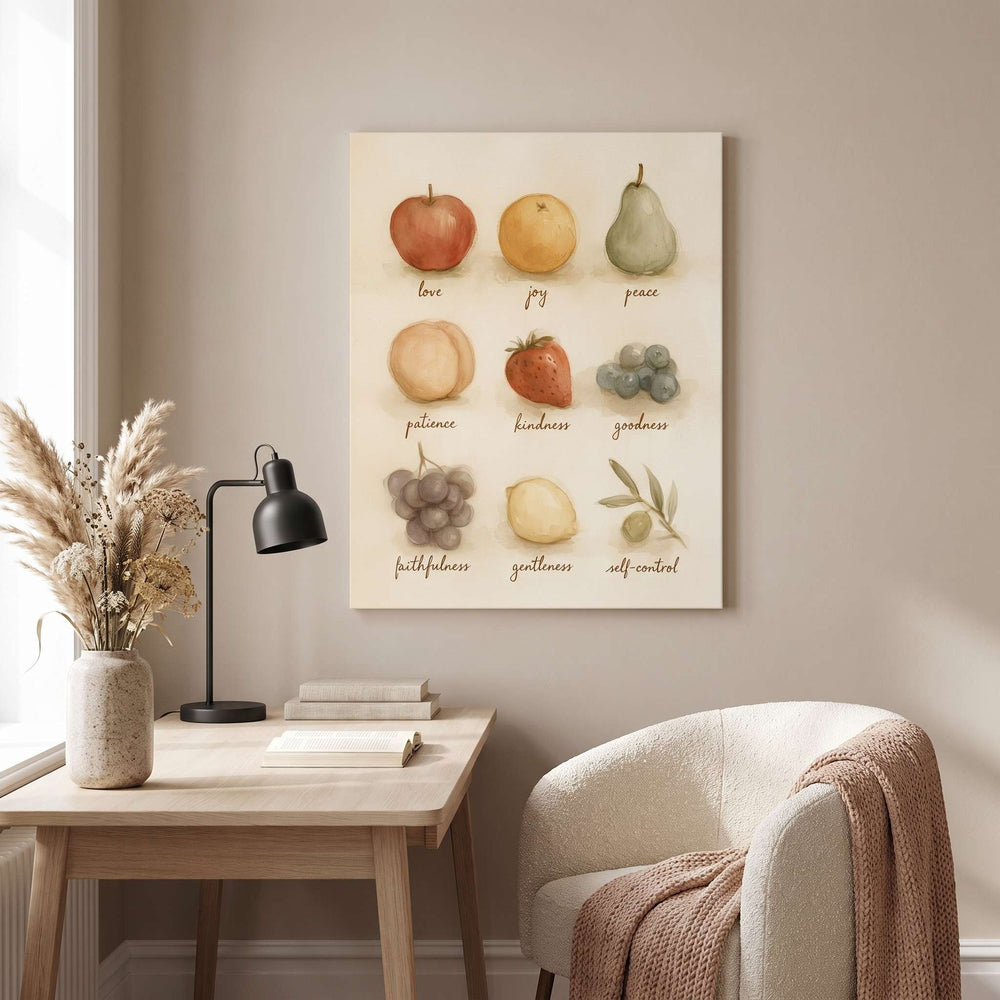
This reading-and-desk arrangement gives the words space around them. The black lamp adds a clear dark accent; the cream chair and pale desk let the fruit supply most of the color. If you use a similar idea with younger children, choose seating and accessible books suited to them. Check furniture dimensions rather than estimating them from the photograph.
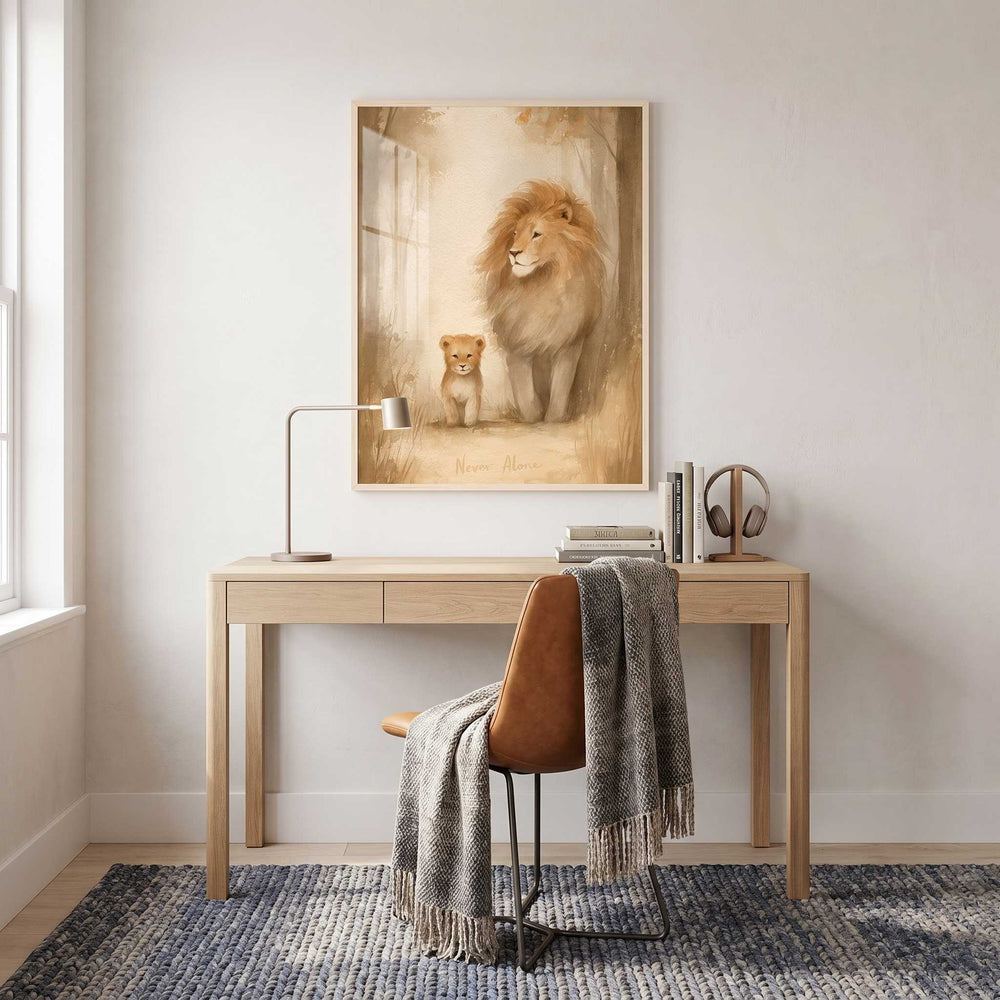
The Never Alone study mockup has books and headphones alongside the animal image. Its honey-brown colors connect with the chair and warm metal lamp. An older child can keep an animal they enjoy without keeping an entire nursery scheme. Invite them to choose the wall, subject, or frame, within the practical limits of the room.
Plan nursery safety before the arrangement
Do not hang framed prints, canvas, mirrors, or other wall-mounted objects directly above a crib where they could fall into it. The American Academy of Pediatrics’ crib-placement guidance advises against picture frames and mirrors above cribs. Choose a separate wall away from the crib and beyond reach; follow mounting instructions and secure nearby furniture. Keep cords and hanging items away from the sleep area. Check the complete room as your child becomes more mobile.
A Room Children Can Grow With
A shepherd picture may first be an animal to name and later a way to explore John 10. Meaning can deepen as interests change. If a child outgrows an illustration, move it to a shared space, store it, or replace it with their own work. New décor is optional.
For broader subject and palette comparisons, our existing nursery and kids’ room art guide is the companion decorating resource.
Simple Ways to Return to the Picture
Let a child tell you what they notice. Read a short related passage when they are interested. Connect one theme to a real moment—an apology, a worry before school, or someone who needs company. Invite a drawing or their own question afterward. You need not do all four things at once.
Our parent guide to art, faith, and character conversations provides fuller activities. Keep them optional and unhurried.
Choosing Christian Artwork for Your Child
Begin with the child’s interests, your family’s convictions, and a biblical subject you can explain. Some households prefer Scripture or creation imagery to depictions of Jesus. Offer an older child a few choices rather than treating the room entirely as an adult project.
Measure usable wall space and compare orientation, viewing distance, and frame size. Test a paper outline before ordering. The featured listings currently offer Poster and Canvas, with unframed choices and finishes including Maple Wood, Golden, Walnut, Black, and White. A framed poster includes a protective acrylic front; canvas has a different surface. Confirm the selected format, dimensions, and mounting guidance.
Let the budget be ordinary too. One piece, an existing Bible illustration, or a child’s drawing can begin a conversation. If artwork is the right choice, browse the Nursery & Kids artwork by subject and available space.
Frequently Asked Questions
Does Christian children’s art have to contain words?
No. A clear image can invite looking before a child can read. A title or accompanying description can identify its biblical connection, and parents can open the passage together. If readable Scripture is your priority, check the lettering at the intended size and distance rather than choosing from the room mockup alone.
Is a Christian animal illustration a Bible story?
Not automatically. The giraffe and lion family featured here are imaginative illustrations connected to biblical themes. Explain that distinction plainly. You can enjoy the animals and discuss the related passage without telling a child that these particular scenes happened in the Bible.
What if my child does not want to talk about the picture?
Leave the invitation open. They may prefer to point, draw, listen, or return another day. Avoid making every encounter a quiz or using the image to shame them after a mistake. Listening, apologizing, offering help, and reading together give Christian words substance in family life.
Can this artwork be a thoughtful gift?
Ask the parents about the subject, religious imagery, colors, and safe wall space before choosing. Include a note about the passage. A book or shared outing may suit the child just as well.
The books, toys, pictures, and drawings will change. What can continue is the habit of paying attention together: noticing, asking, reading, and listening. Lamb’s Love’s mission is “The Story of God’s Love, Made Visible.” In a child’s room, that can begin with a lamb, a gathering around Jesus, or a familiar fruit—and grow into a conversation about the God who made us, Christ who saves us, and love practiced at home.

